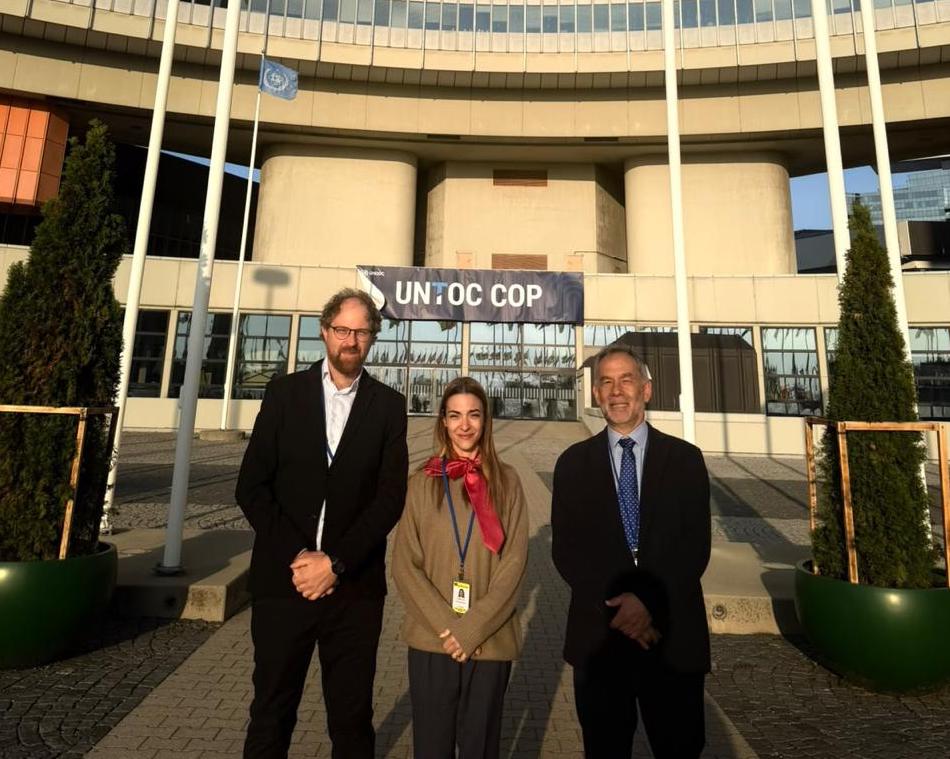

From October 19 to 23, governments from several countries, United Nations agencies, civil society organizations, and Indigenous leaders gathered at the Vienna International Centre for the 13th Conference of the Parties to the United Nations Convention against Transnational Organized Crime (UNTOC COP13).
The conference ended with a historic decision, marking progress toward a protocol on crimes that affect the environment and recognizing the role of Indigenous peoples and local communities.
For Amazon Underworld, it was also our first participation in a UNTOC Conference of the Parties with observer status, with a panel of our own, the co-organization of three other events, and the launch of an executive summary of our investigations into illegal gold and critical minerals extraction in the Colombia-Venezuela border region. We also had a voice in the conference plenary, where we presented key data from our reports.
About the protocol
On Friday, October 23, States approved the creation of an ad hoc committee to negotiate an additional protocol to the Palermo Convention on crimes that affect the environment. The protocol will address trafficking in wildlife and flora, including timber, illegal mining, trafficking in minerals and precious metals, and waste trafficking.
It will be the convention’s fourth protocol, alongside the existing ones on trafficking in persons, migrant smuggling, and arms trafficking.
About a dozen States, led by the United States, opposed the process from the start. They put forward three amendments that would likely have delayed the process and complicated its funding. At Brazil’s request, the amendments were put to a vote and defeated one by one.
The resolution was then adopted with 83 votes in favor, 12 against, and 27 abstentions, or 87.37% of the votes. The United States, Argentina, and Israel voted against, as did Saudi Arabia and Venezuela.
The resolution was introduced by Brazil, Bolivia, Colombia, Costa Rica, the Democratic Republic of the Congo, Ecuador, Mauritania, Panama, Peru, São Tomé and Príncipe, and Uruguay.
For the first time, the text explicitly recognizes the role of Indigenous peoples and local communities in combating environmental crimes and associated corruption, although it does not create a mechanism to guarantee their participation in the negotiations.
The committee will hold four sessions, with the goal of presenting a draft at COP14, two years from now. The protocol was one of six resolutions adopted at COP13, which brought together more than 2,100 participants from 142 countries, representatives of 320 NGOs, and 115 side events.
The decision was built over years by the Brazilian government. In 2024, COP12 adopted resolution 12/4, proposed by Brazil, France, and Peru, which created an intergovernmental group of experts to assess gaps in international law. The group met in 2025 and in February 2026 but failed to reach consensus on recommendations, leaving the decision on whether to open negotiations to Vienna. In November 2025, Brazil launched the Coalition for Multilateral Action against Crimes that Affect the Environment, which Amazon Underworld joined alongside the Igarapé Institute, the CIPÓ Platform, GI-TOC, Freeland, WCS, EIA, and the Wildlife Justice Commission.
The next two years will determine whether the protocol becomes a real tool or merely a statement of intent. For Amazon Underworld, the priorities are: keeping illegal mining and mineral trafficking explicitly within the protocol’s scope, ensuring a clear mandate and timeline, and securing the effective participation of Indigenous peoples and civil society. We will continue bringing evidence from the territories to events like this one.
Our activities
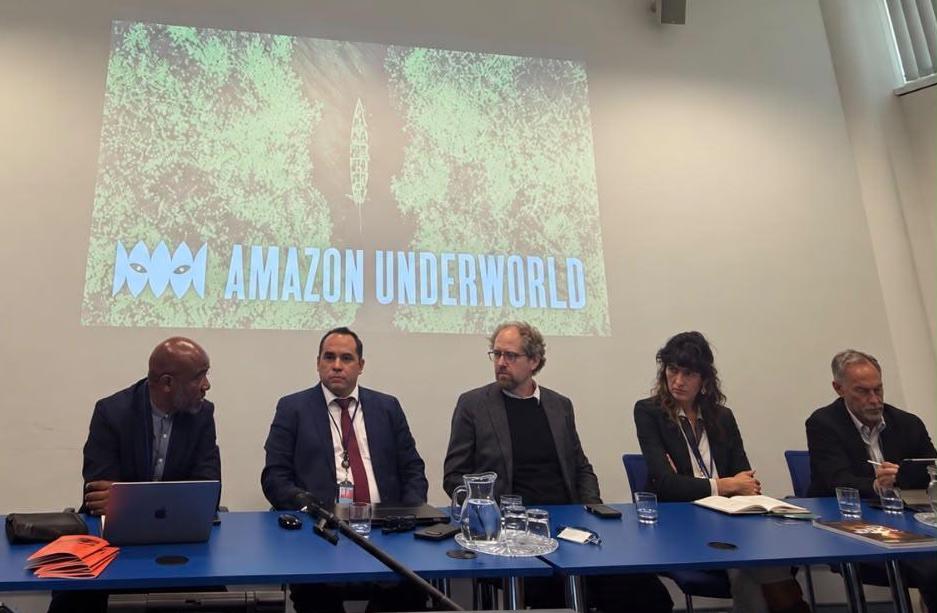
On October 20, together with Amazon Watch and with the support of GI-TOC, we held the event “The Energy Transition and Organized Crime in the Amazon: Illegal Mining, Illicit Economies and the Governance Challenge for UNTOC”.
The panelists were Carlos Sánchez del Águila, a Peruvian diplomat and Chair of the Intergovernmental Group of Experts on Crimes that Affect the Environment under UNTOC; Albert Barume, UN Special Rapporteur on the Rights of Indigenous Peoples; Sophia Pickles, Senior Analyst at GI-TOC; Bram Ebus, founder and co-director of Amazon Underworld; and Mauricio Cabrera, former Vice Minister of Environment of Colombia, who spoke about the environmental and social pressure of gold and strategic minerals in the Amazon. Julia Almeida, advocacy advisor of Amazon Underworld, moderated the panel.
The event also marked the launch of our executive summary “Gold and critical minerals in the Amazon: The undeniable link to organized crime in Colombia and Venezuela”.
The following day, we co-organized, with Amazon Watch, the governments of Brazil and Peru, the Association of Indigenous Councils of Villagarzón Putumayo, AIDESEP, and GI-TOC, the event “State Strategies and Indigenous Peoples’ Participation in Security and Anti-Crime Policies: Lessons from the Amazon”.
In that space, community and Indigenous leaders shared their perspectives on the fight against crime.
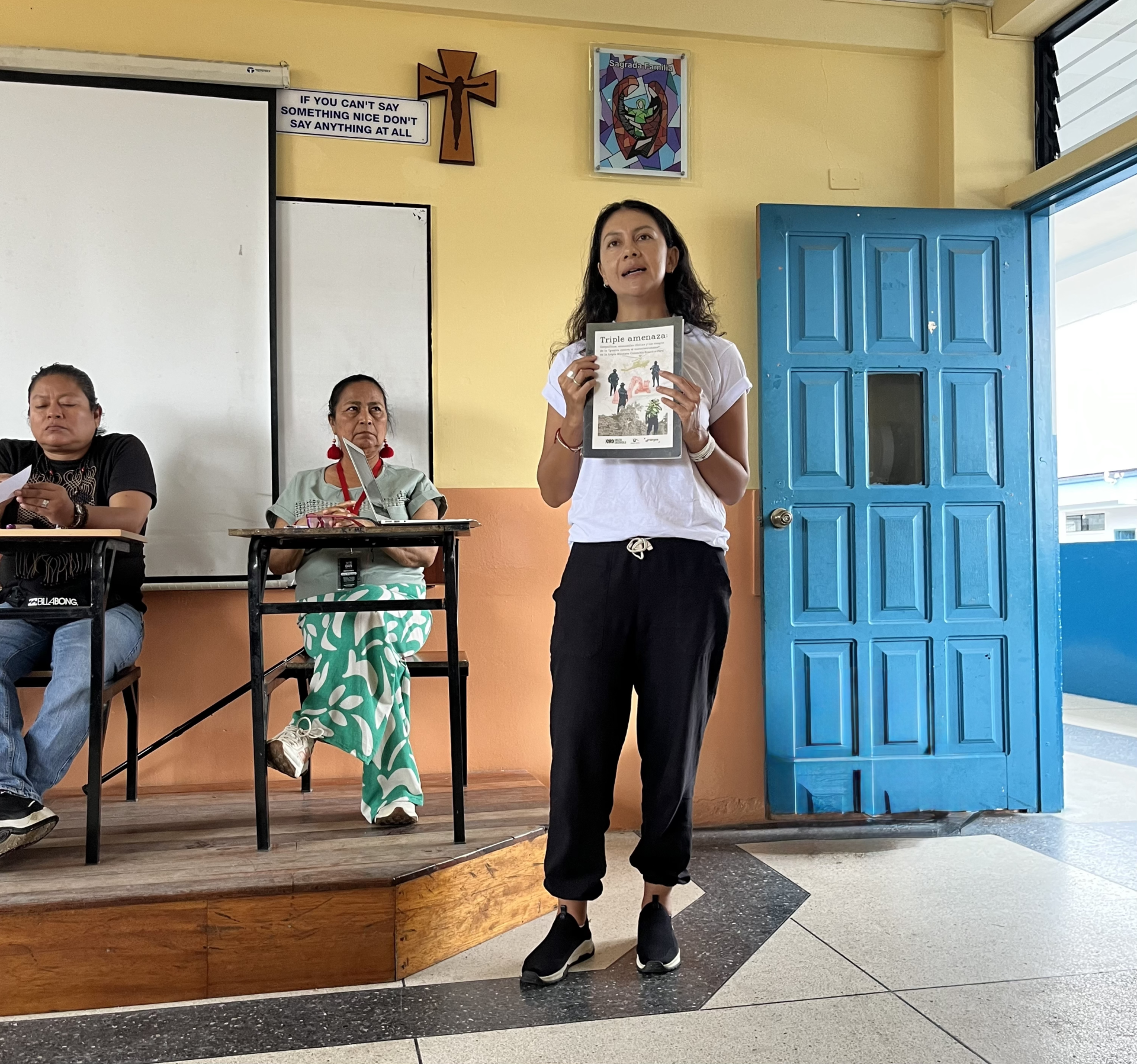
In addition, a delegation of about ten Indigenous leaders from Brazil, Colombia, Ecuador, and Peru, coordinated by Amazon Watch, addressed the plenary and argued that Indigenous territorial governance should be recognized as a pillar of global security. The message was clear: there is no security in the Amazon without Indigenous peoples. As Galois Flores of the Wampis Nation put it, isolated police operations fail because illegal groups return as soon as security forces withdraw.
Another of the co-organized events, the panel “Illegal Mining, Trafficking of Minerals and the Case for Stronger International Cooperation”, took place on October 22, together with WCS, the governments of Brazil, Peru, South Africa, and the United Kingdom, and the UNODC Research and Trend Analysis Branch. Attendees learned about the scale and impact of illegal mining and the lack of a comprehensive international legal framework to address it.
On October 23, the International Council of Environmental Law organized the event “Towards a New Protocol to the UNTOC on Crimes that Affect the Environment”, co-organized by the governments of Brazil, France, and Peru and about twenty organizations, including Amazon Underworld.
Amazon Underworld at the plenary
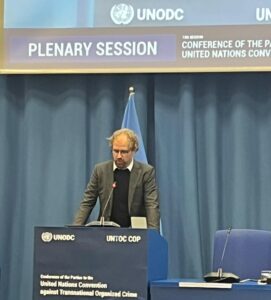
On behalf of Amazon Underworld, Bram Ebus addressed the plenary before the delegations present. His message focused on three points: first, that organized crime is transforming governance in the Amazon (as we showed in our recent report “Crime Presence in the Amazon 2026“); second, that environmental crimes linked to the extraction of critical minerals have global consequences, since the damage stays in the Amazon while the profits flow to the United States, Europe, and China; and third, that national responses so far merely shift the problem elsewhere without tackling it at its root or comprehensively.
In this context, a global protocol is an opportunity to jointly investigate the flows of gold and minerals, demand traceability from consumer countries, and recognize Indigenous peoples as guardians and security actors.