

It's deep into the night, and everything suggests the burial will take place on Sunday. Armed men stand watch around the coffin. The people of Santa Catalina have long since gone to bed, but at least eight rounds of gunfire shatter the quiet. New settlers are claiming territory in a wild region that the Spanish once thought was destined to be the most productive in the Americas.
In Venezuela’s far east, along the river route to the mouth of the Orinoco, dozens of uniformed and armed men move freely—men identified by locals as dissidents from Colombia’s Revolutionary Armed Forces (FARC). They travel unimpeded and control the movements of drugs, goods, and passengers along the river.
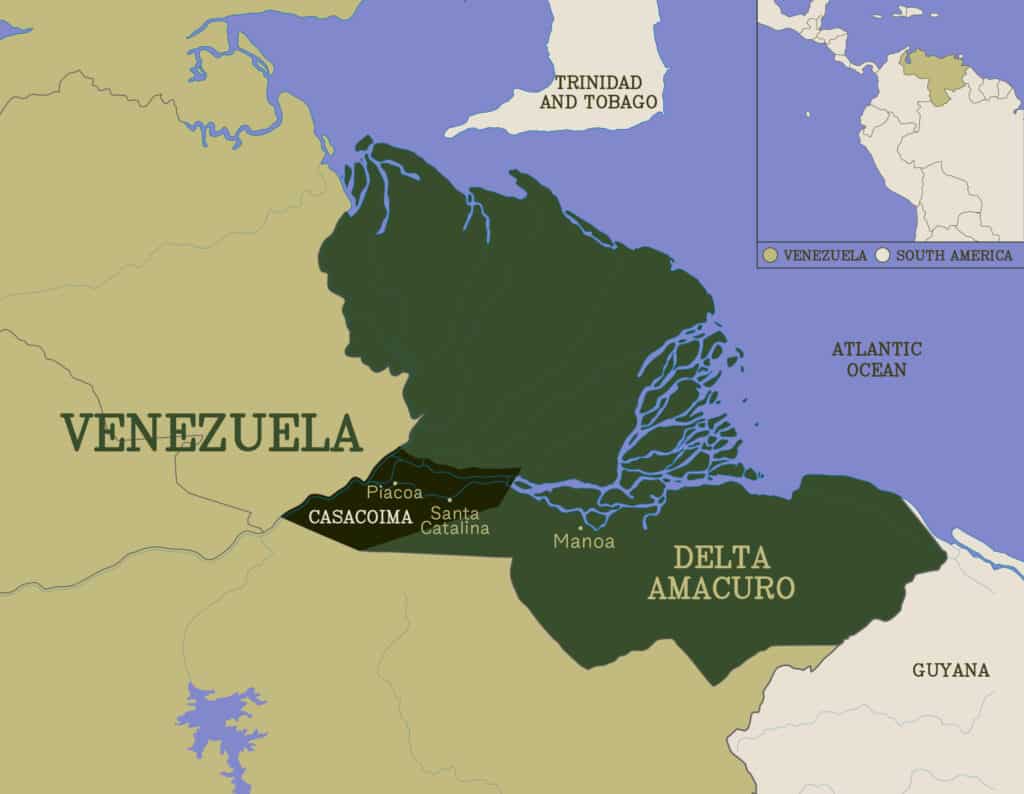
Like the colonizers of old, they have chosen Santa Catalina as their strategic base; a mission town founded in the 18th century and capital of Rómulo Gallegos parish in Casacoima municipality, Delta Amacuro state.
It is late February and the rain is torrenting down. Pedro Fernández, a 53-year-old fisherman, says the cabañuelas—an ancestral method for predicting the weather for all 12 months of the year, widespread throughout Spanish America—are proving accurate.
Santa Catalina sits along the winding route of the so-called “Father River” — Venezuela’s mightiest waterway and the world’s fourth-largest river by discharge volume — toward the mouth of the Orinoco Delta, where it meets the Atlantic Ocean.
The downpour keeps Pedro and town’s 1,5000 residents indoors.
But Pedro doesn’t want the rain to stop. Not for the good it might do to the drought-hardened land or the cattle grazing on Tórtola Island across from the community, but because he thinks maybe the downpour—sometimes just a drizzle—will “dispel the bad energies” and bring some calm to a town that has grown increasingly violent in recent years.
UNFAMILIAR PROSPERITY
Until just a few decades ago, Santa Catalina had all the makings of paradise. Not only because of its prime location on the banks of the Orinoco, its spectacular Amazonian biodiversity, and its cultural richness. In the past, those who traveled through Venezuela’s most remote southern territories recognized its economic potential: When the Federal Territory of Delta was created in 1884, Santa Catalina became one of the operational centers for the New York-based Manoa Company, which sought to exploit the region’s wealth.
Later, James E. York, manager of the American company Orinoco Iron Company, documented in 1897 after a trip to Santa Catalina that he had never seen iron deposits of such high grade, “not even in Minnesota’s Mesaba Range,” according to Luis Ugalde, a Jesuit theologian and philosopher, in his studies on colonization projects in Guayana during the 18th and 19th centuries. “The quality of the ore is far superior to that of Spain and Africa, with which it will compete,” notes an article from that year in the Venezuelan Herald.
The same newspaper piece cited by Ugalde envisioned a “rosy future and prosperity hitherto unknown in the Delta Territory”—a remote and jungle-covered region in Venezuela’s far east, crisscrossed by dozens of channels and waterways known as caños.
Santa Catalina was then designated as the heart of the operation, and it was there that the Orinoco Iron Company built its headquarters and a two-story hotel with two wings housing 23 rooms. The company outpost had around 200 people and they hoped to expand it with cheap transportation and free land to exploit balata—a natural gum resin similar to rubber—and other resources. To this end, the company installed a steam plant for processing and made progress on road construction, including Minnesota Street, as the town’s main thoroughfare was known.
Long before the Americans arrived, the British and Spanish had already recognized and exploited the region’s economic and strategic advantages. More than a century later, it was only natural that everything would change—and everything did.

But the transformation wasn’t as many had predicted. Residents say that Santa Catalina and the nearby communities along the Orinoco no longer receive any visitors: no municipal or state authorities, no tourists, no adventurers like York. No one except their new colonizers: armed men in uniform who, upon arriving in the town, wore armbands of Colombia’s Revolutionary Armed Forces (FARC), and who over the past decade have expanded along the Orinoco River.
Beyond the National Liberation Army (ELN) guerrilla, at least two groups operating under the FARC banner are currently active throughout Venezuela. These include new recruits as well as fighters who never signed the 2016 Peace Accord between the Colombian government and the FARC that saw the guerrilla group’s main faction demobilize, alongside those who abandoned the process altogether.
Along the Colombian border, along Venezuela’s far west—more than 750 kilometers from the Delta if measured from the nearest border point—operates the Estado Mayor Central, commanded by alias “Iván Mordisco”. Meanwhile, the Segunda Marquetalia, led by the FARC’s onetime lead negotiator and severely-wounded Iván Márquez, maintains a deeper territorial presence.
THE NEW SETTLERS
The rain has stopped and the sky turns orange. The engine of a motorboat alerts those near Santa Catalina’s port. “Here they come,” say a couple of bystanders.
The boat, painted with red and green stripes, reaches the riverbank. Less than two meters away, children play and dive into the water. Fourteen men wearing rubber boots and camouflage shirts disembark, carrying weapons. At least four stay close and lift a coffin with golden arabesques. Others carry flowers.
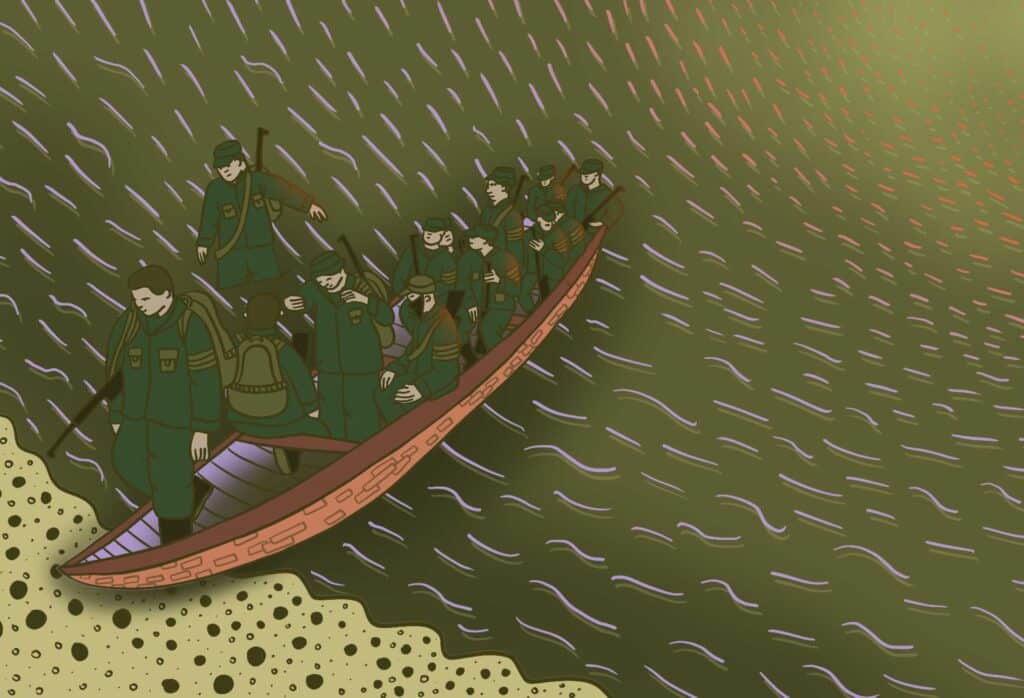
It’s February 22, 2025, and the funeral of “El Viejo” —the former guerrilla leader who was murdered, according to Santa Catalina residents, in September 2024 – is underway.
The downpour didn’t halt preparations. At the cemetery, they’ve already dug the grave. Just meters from the port, they’re preparing soup and spit-roasted meat. There are civilians mixing with the armed combatants. Several women seek out those closest to the Church and ask them to attend the burial to pray the rosary.
They’re holding the wake for “El Viejo”—the alias of a man named Aldemar Suárez—just meters from Bolívar Plaza, outside a bar. Every so often, they spray something around the coffin, perhaps to ward off bad odors. El Viejo’s erstwhile entourage surrounds the casket. His sons are also in attendance: Juan, nicknamed “güipa,” the eldest; Daniel, who replaced him as leader of the group controlling the territory; and Joandry, the youngest. All are of Colombian origin.
“The community must be grateful because he died for all of us. He fought his entire life, first in Colombia and then in Venezuela, for an ideal of freedom. He identified so strongly with Venezuela that he gave his life for it,” says a mourner before Suárez’s coffin—a man described as cultured, charismatic, and humble who lived to be 60.
They arrived in Santa Catalina in 2020 under the banner of freedom, just before the COVID-19 pandemic. The first thing they did was call the community to an assembly, which about 30 people attended. “They said they wanted to make a life here. The one who led the meeting identified himself as Commander Camilo—he had a Colombian accent—and he said, ‘How nice it would be if when I came by, you’d say “Don Camilo, let’s have some coffee.”‘ They asked for the community’s support. Nobody told them no, but nobody said yes either,” recalls Gustavo Lazarde, a 61-year-old Santa Catalina resident.
“RIGHT NOW YOU HAVE PROBLEMS WITH ELECTRICITY AND WATER—WE CAN SOLVE ALL OF THAT,” COMMANDER CAMILO TOLD THEM.
“WE ALL JUST LOOKED AT EACH OTHER,” RECALLS GUSTAVO, A DARK-SKINNED MAN WITH A QUIET VOICE, PERHAPS SURPRISED BECAUSE SANTA CATALINA INDEED HASN’T HAD WATER OR ELECTRICITY FOR MORE THAN A DECADE.
“Yes, even if you don’t want to believe me. You can’t imagine what passes right under your noses. If we charged for everything that goes by, you’d have three or four power plants,” the uniformed man emphasized.
What Don Camilo was referring to, Santa Catalina residents agree, was the movement of drugs and, to a lesser extent, minerals and other goods along the Orinoco River—the main revenue stream for these groups.
A KEY LOCATION
Moving through and controlling drug and gold trafficking along the Orinoco River isn’t coincidental. Its mouth connects to the Atlantic Ocean, and several events confirm the strategic nature of this waterway for illicit economies.
In early March 2023, the operational strategic commander of the Venezuelan National Armed Force (FANB), Domingo Hernández Lárez, announced on X the intervention of a “camp belonging to criminal groups associated with drug trafficking” and the seizure of a “semi-submersible submarine” used for drug trafficking, during operations in the Orinoco River delta.

In December 2020, the prosecutor for the Public Ministry in Delta Amacuro, Guerlys Hernández Urrieta, and her husband Jorge Luis Hernández, were arrested for their alleged connection to the seizure of 2012 synthetic drug pills from a boat in Orinoco waters. “The proximity of Delta Amacuro state’s coastline to Trinidad and Tobago makes this region conducive to drug trafficking. Drugs arrive there in shipments that tend to be smaller and travel in smaller boats,” notes a 2024 report by Transparencia Venezuela.
An intelligence source confirmed that semi-submersibles transport cocaine offshore, northeast of Trinidad and Tobago, where the cargo is transferred to ocean fishing boats and container ships bound for Europe and West Africa. Since these vessels sail under non-Venezuelan flags, Venezuela rarely appears in seizure data, despite the Orinoco Delta being considered a drug trafficking hotspot, with “few barriers” for traffickers. To a lesser extent, this region is also used to move drugs to Guyana, before sending them to international destinations.
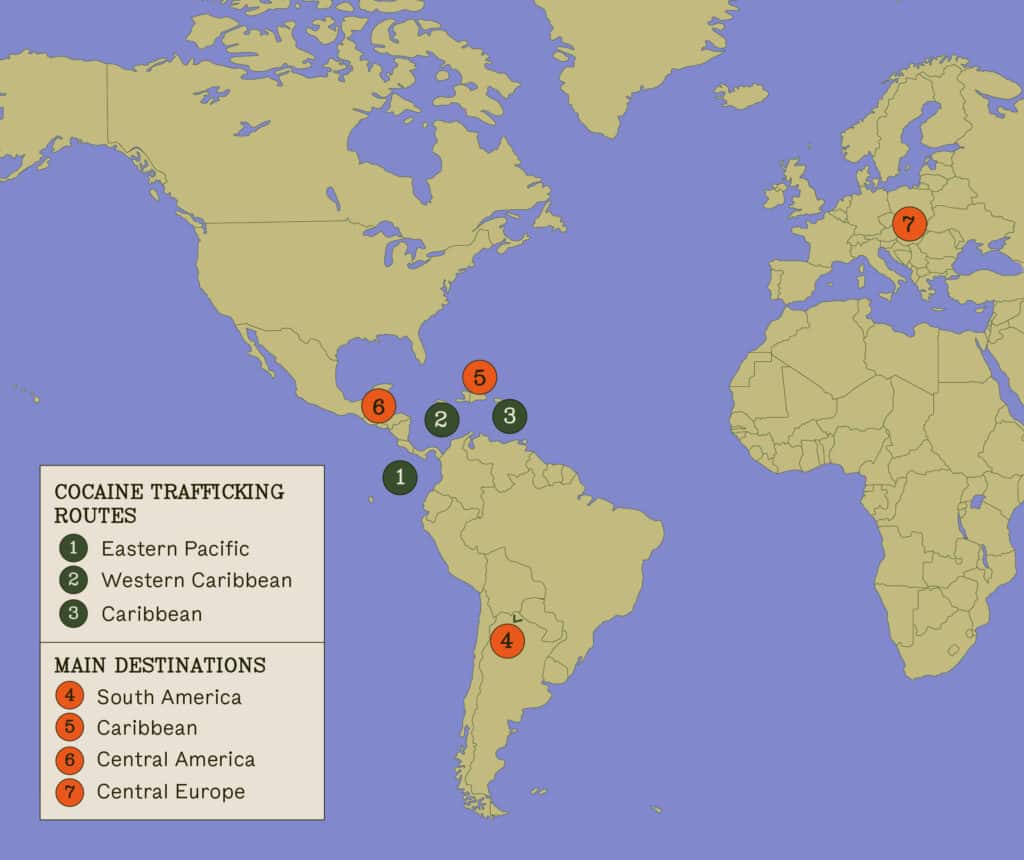
According to U.S. authorities, cocaine trafficking to Guyana typically begins in Andean nations, according to the 2021 report by the United Nations Office on Drugs and Crime (UNODC). Three routes have been identified: the eastern Pacific route, estimated to account for 74% of the total; the western Caribbean route (16%), which originates in Colombia; and the Caribbean route (8%), which starts from both Colombia and Venezuela. This route is notable for its use of speedboats and aircraft for trafficking.
UNODC doesn’t identify Venezuela as a country of origin or destination, but rather as a transit country for cocaine. Colombia, meanwhile, is identified as the country of origin for seized cocaine shipments between 2016 and 2020. The main destinations are South America, the Caribbean, Central America, and Central Europe.
Lazarde says that after that first assembly, “[the dissidents] started coming to visit… since they arrived in town they say they come on government orders.” In the early months of their arrival, he recalls, people preferred not to go out on the streets. They feared clashes with the Barrancas sindicato, an organized crime band with Venezuelan leaders that control drug trafficking and goods along the river between Barrancas del Orinoco in Monagas state and Piacoa on the southern bank in Delta Amacuro. Like Santa Catalina, Piacoa is part of Casacoima municipality and holds a strategic position accessible by both land and water.
From Piacoa eastward, control is held by those identified as FARC dissidents, who initially set up their base in a sector known as Catalinita and later in Mena. Now they reach the Amanoco channel, about 20 minutes from Santa Catalina, and maintain a presence in La Fe, a community near Piacoa.
They travel in boats with up to two engines: the noise by which the community identifies them. They no longer wear the FARC armbands they used in the past. “I think they’ve become more autonomous. “They identify themselves by their leader,” says a Santa Catalina resident.
FIGURES OF POWER
Until September 2024, the leader was “El Viejo.” Locals say he was betrayed and murdered by members of his own faction. He was at the camp, the story goes, and they told him they were going to replace him with someone else, so he decided to dissolve it and dismissed everyone. But those who wanted to oust him shot him dead to seize control.
Then, according to testimonies, his sons returned, regrouped, took revenge, and seized control once more. “They discovered where he had been buried, between La Fé and Piacoa, dug him up, and brought him back to bury him here.”
The uniformed men come to Santa Catalina to buy food, drink alcohol, and party at night. Most of the time they pay in dollars, though the community also accepts bolívars, Venezuela’s official currency. Since their arrival, locals acknowledge, cattle and chicken thefts have stopped. Even so, the community rejects them, but can’t do so openly. “The community listens and that’s it. We haven’t dared tell them no, and within the community there are those who have established relationships with them. At one point they started taking young men, sounding them out, offering them payment in dollars, cell phones, and even soccer balls,” says Lisa Méndez, a 43-year-old housewife.”
“You have to learn to greet them politely. ‘How are you? Good evening.’ Sometimes they stay quiet or they might ask you something and then give you a little talk: ‘We’re here to protect the community, don’t worry, this is a territory of peace.”
One of the concerns of Santa Catalina residents is that there are precisely no police, no National Guard, and no river patrol. The Organic Law against Illicit Drug Trafficking and Consumption of Narcotics and Psychotropic Substances, repealed in 2010, established in Article 104 that in Delta Amacuro, given its geographic configuration, a comprehensive system of intelligence, prevention, and prosecution against drug trafficking would be created, integrated by the Navy, the Bolivarian National Guard (GNB), the Scientific, Criminal and Forensic Investigation Corps (CICPC), and the Public Ministry. These would constitute a Special Task Force for the control and surveillance of rivers and channels, thereby “preventing the Delta, given its vulnerability, from becoming a preferred zone for drug trafficking activities and a seat of corruption of civil society and institutions in that border state, including protecting the habitat of indigenous peoples settled there,” the document stated. But the plan remained theoretical—it was never implemented.
Across from “El Viejo’s” wake stands a small building with commercial spaces where a National Guard command post operated until just a couple of years ago. In the 1990s, Santa Catalina residents recall, there was just one assigned police officer.
“Now it’s not just that there are no police forces—there are no state entities for child protection, no women’s protection services, there’s nothing. So, where are you going to file a complaint? With what boat, with what internet?”
Josefa Gómez*, 50-year-old housewife.
Just over a century ago, the community looked toward the future. Today, the list of needs is extensive, and the armed group’s settlement in the town—despite the promises made in that first assembly—hasn’t positively impacted the community either. There has been no electricity for more than 10 years, and those who have power get it from gas generators or small solar panels. There’s also no running water, despite the community sitting right across from the mighty Orinoco and having a giant tank that could supply all of Santa Catalina. There’s no public transportation for medical emergencies or to obtain supplies and food. Dozens of houses stand empty due to outward migration.

When Diliana, a 16-year-old student, left with the guerrillas one night in late May 2023, her relatives Mariana and Daniel* couldn’t find a police officer or guard to ask for help. So they went looking for her the next morning with support from the women in the community.**
“Mom, I have the worst news. Diliana left with a rubber boot,” Daniel told his mother.*
“Did they take her by force?” she asked.
“No, she left on her own.”
Diliana had voluntarily gone with Juan, the eldest of “El Viejo’s” three sons. They both walked to the guerrilla camp along an overgrown and muddy path. Her family suspects Juan courted her over the phone.
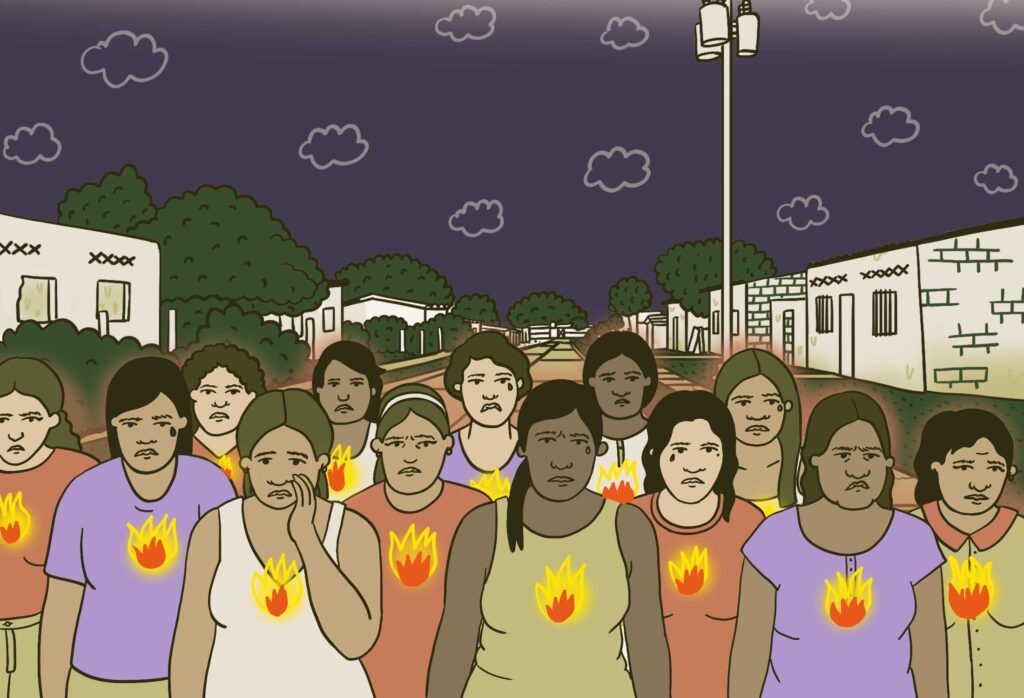
THE MORNING AFTER THE ESCAPE, THE WOMEN ORGANIZED THEMSELVES, SPREADING OUT THROUGH THE TOWN’S FEW STREETS AND GATHERING OTHERS AS THEY WENT.
“COME ON, NOTHING’S GOING TO HAPPEN TO US,” MARIANA TOLD THEM. “AND SO WE WENT—34 WOMEN IN A HUGE DUGOUT CANOE,” SHE RECOUNTS.
DURING THE JOURNEY, THE WOMEN WERE CRYING.
“There were men, but we didn’t think it was wise for them to go. We thought they wouldn’t do anything to us. Bringing men could be seen as a provocation,” she explains. In the dugout canoe—a wooden boat typical of Venezuela’s indigenous populations—only three men went: her father, the boat operator, and a minor who knew the route.
The leader they needed to speak with to bring Diliana back was “El Viejo.” Mariana remembers they reached the shore and as they walked to the camp, there was a surveillance detail in the brush: uniformed men who stayed out of sight. Before the women, “El Viejo” insisted the young woman hadn’t been forced. The women asked to see her.
They waited two hours. Diliana, dressed in civilian clothes, came with two women. She stopped 200 meters away. She didn’t want to walk any further. She wasn’t speaking or answering questions. “I gathered my courage and walked through the middle of the men who had their weapons crossed to block our way. I grabbed her and we carried her by the arms. She resisted, she wanted to stay,” Mariana recounts.
On the trip back to Santa Catalina, Diliana wanted to throw herself into the river. Two guerrilla boats followed them, but sped ahead and arrived first. “When we got there, there were so many people. We went up and left her at the house,” Mariana recalls. She adds that they had to sedate her to calm her down.
Taking advantage of the guerrillas’ presence in the community, they called a meeting—they estimate it would be the third since they had settled there. It was 11 a.m. on May 23rd. They needed to establish boundaries, but “El Viejo” didn’t attend the gathering. “We told them we didn’t want them in Catalina. That we prayed a lot for them to leave the community. One of the women confronted them and told them that if they wanted to recruit children, they should go back to Colombia: ‘Respect our children, you’re violating their rights,'” recalls José Pereira, a 45-year-old shopkeeper.
“We’re here because the government has allowed it. We’re not here in an improvised way—we’re here because the government wants us to be,” one of them responded.
“We’re not gang members or guerrillas. We don’t want to thank you or any sindicato. The fact that you’re here puts us at risk,” Mariana replied, who admits the situation terrifies her and has cost her sleep.
Three meters from “El Viejo’s” coffin, while a dozen women pray the rosary, a cluster of children no older than 10 runs, shouts, and jumps around. As for the men, in one corner they drink beer; in another, they play dominoes. The funeral is the day’s gossip. The community fears that their presence in town is becoming something normal; they’re especially worried that children are growing up seeing everything they see because, they assure, the kids already idolize them, see them as figures of power.
“Are they guards, mommy? Are they police?” Karina asks her mother, seeing the handful of men on one of the town’s main streets—the old Minnesota Street.*
“They’re police,” Mayra responds curtly, to avoid going into details and without clear explanations about why these men are there.
*The names used in this story have been changed to protect the safety of the sources.

