The Amazon rainforest, the world’s largest, has increasingly become hostile territory. In many areas—especially those near international borders—organized crime has become a dominant force.
A new research by Amazon Underworld indicates that at least 67% of a total of 987 Amazon municipalities in six main countries (Bolivia, Brazil, Colombia, Ecuador, Peru and Venezuela) face the presence of criminal networks or armed groups. No presence or information was found in the remainder.
Of these, 32% faced more than one group in their territories, and seven criminal or armed groups operate between two and four different countries covered in this study.
987
MUNICIPALITIES in six countries were researched by Amazon Underworld during 2025 for this report. In 662 (67%) we found the presence of at least one armed group.
211
MUNICIPALITIES of the 662 where Amazon Underworld was able to gather information have more than one armed group in their territory.
7
ARMED GROUPS already have a presence in more than one country’s Amazon: Comando Vermelho, PCC, Comandos de la Frontera, Segunda Marquetalia, Estado Mayor Central (EMC), ELN and Los Choneros.
The arrival or expansion of armed groups represents an inflection point for many local communities, who see their natural environment being destroyed, violence reaching record levels and their youth being enticed by the economic allure of activities like gold mining and drug trafficking.
Young people are recruited into armed structures offering monthly payments never before seen in their communities.
Those who publicly voice concerns about criminal control face threats or assassination, especially in Colombia and Brazil. Entire populations are driven from their villages while others remain confined within their community boundaries due to ongoing fighting or the presence of landmines.
If one asks when organized crime prevails, unfortunately in many regions local populations would argue that time is right now. In large swathes of the Amazon territories, illicit economies are the dominant activity. Sometimes these illegal operations generate more revenue locally than the budgets of state agencies tasked to combat them. Armed groups have begun governing territories, dictating curfews and controlling mobility over rivers and rural areas. They sometimes force populations to open new jungle roads and carry out rudimentary forms of justice with violent punishments for those who disobey their rules. These rules extend to behavioral patterns, requiring residents to carry ID cards issued by armed groups, and even social cleansing.
Meanwhile, Amazon cities experience increased violence alongside ongoing challenges with prison overcrowding and substance abuse, while displaced populations from rural areas continue to arrive. In the Amazon’s criminal landscape, alliances form across borders. Colombian armed groups coordinate with Brazilian crime syndicates from cities as distant as São Paulo. State forces sometimes join these partnerships—Venezuelan political authorities and security forces team up with Colombian guerrilla organizations, even holding joint meetings with local communities involved in illegal gold extraction to divide profits. Other cooperation remains relatively hidden, such as cases where Brazilian Military Police work with crime groups or accept payments from them.
The economic nature of these alliances in the criminal underworld makes them volatile, as demonstrated in Venezuelan borderlands with Colombia. Cooperation between the National Liberation Army (ELN) and FARC dissident front Acacio Medina, belonging to the Segunda Marquetalia franchise, came to an abrupt end in early August 2025 when the ELN attempted to assassinate members of Acacio Medina during what appeared to be a setup.
So, why should the world care? The Amazon is far more than a regional ecosystem—it is a critical pillar of global climate stability that stores approximately 34 billion tons of carbon in its Indigenous territories and protected lands alone. Scientists warn that this vast rainforest stands dangerously close to an irreversible tipping point where it could transform from a global carbon sink into a major carbon source, making international climate targets virtually impossible to achieve and dramatically accelerating worldwide climate change. The ecological collapse would be triggered once deforestation reaches 20-25% of the original forest cover and with approximately 17% already cleared, this threshold appears increasingly within reach.
Those proven to be most capable at forest conservation in the Amazon—Indigenous peoples—are increasingly targeted by organized crime as they present obstacles to criminal advancemen.
Indigenous communities impose natural barriers through guard groups that detect illicit activities and collective land management practices. They view forestry not only as an ancestral way of life but also as resistance to illegal activities. However, this sometimes causes internal disputes, as evidenced in clashes between pro- and anti-mining Indigenous communities along the Santiago River in Peru. Protecting their community life, defense mechanisms, and viable livelihood alternatives is essential for the Amazon’s protection and survival.
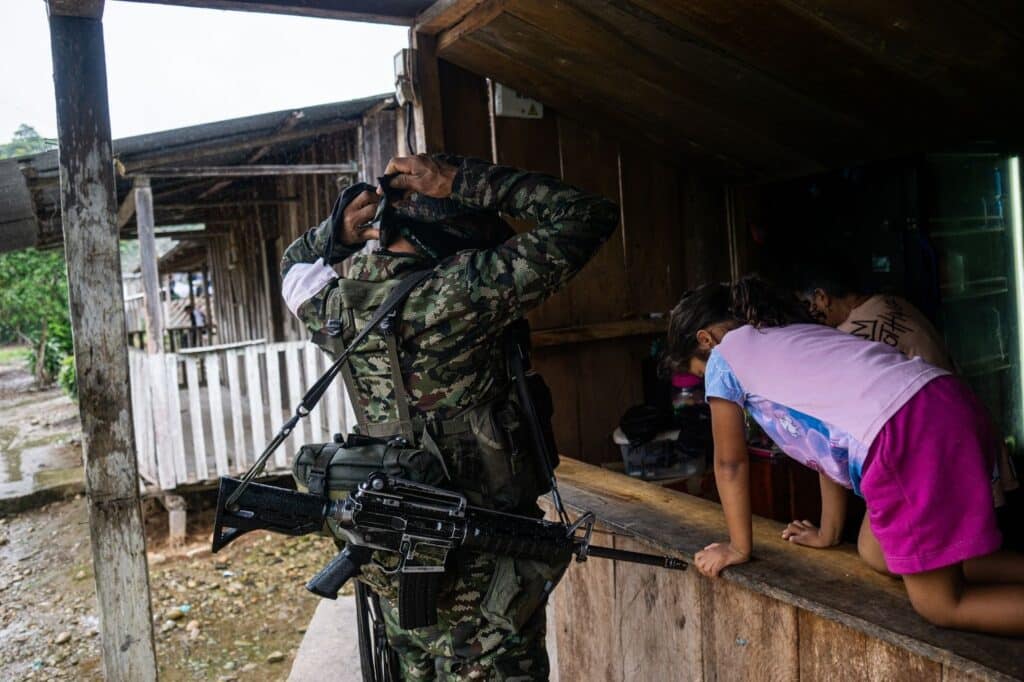
In this document, we present an overview of organized crime and armed groups operating throughout the Amazon Basin, analyzed by local administrative divisions (municipalities, districts, cantons, etc.). The research was conducted in 2025 and the data for the cartography was collected via interviews with primary sources in the territory, researched documents from state agencies and filed petitions for information.
These maps reproduce the interactive tool available at www.amazonunderworld.org, which provides more comprehensive data on each group’s presence by municipality.
Colombia’s conflict spilling
Colombia’s internal conflict fragmented after a 2016 peace deal that successfully demobilized over 13,000 combatants of the Revolutionary Armed Forces of Colombia (FARC). However, faltering implementation during the Iván Duque and current Gustavo Petro administrations failed to address many root causes of the conflict. Failed efforts at building or rebuilding state presence in abandoned and conflict-ridden territories enabled new criminal outfits, armed groups and FARC dissident groups (those who never signed the 2016 peace deal or rearmed thereafter) to escalate violence in territories rich in natural resources or crucial drug trafficking corridors.
President Petro’s total peace strategy, aiming to negotiate solutions with armed and criminal groups, led to ceasefires between state forces and non-state armed groups. Nevertheless, this unintentionally facilitated ongoing violent competition between non-state armed groups without the state necessarily becoming a target. After several negotiations failed and ceasefires were halted, armed groups redirected their violence back toward the state, with government forces increasingly coming under attack through bombings, sometimes involving drones, and the coerced mobilization of unarmed civilians as human shields to halt army operations.
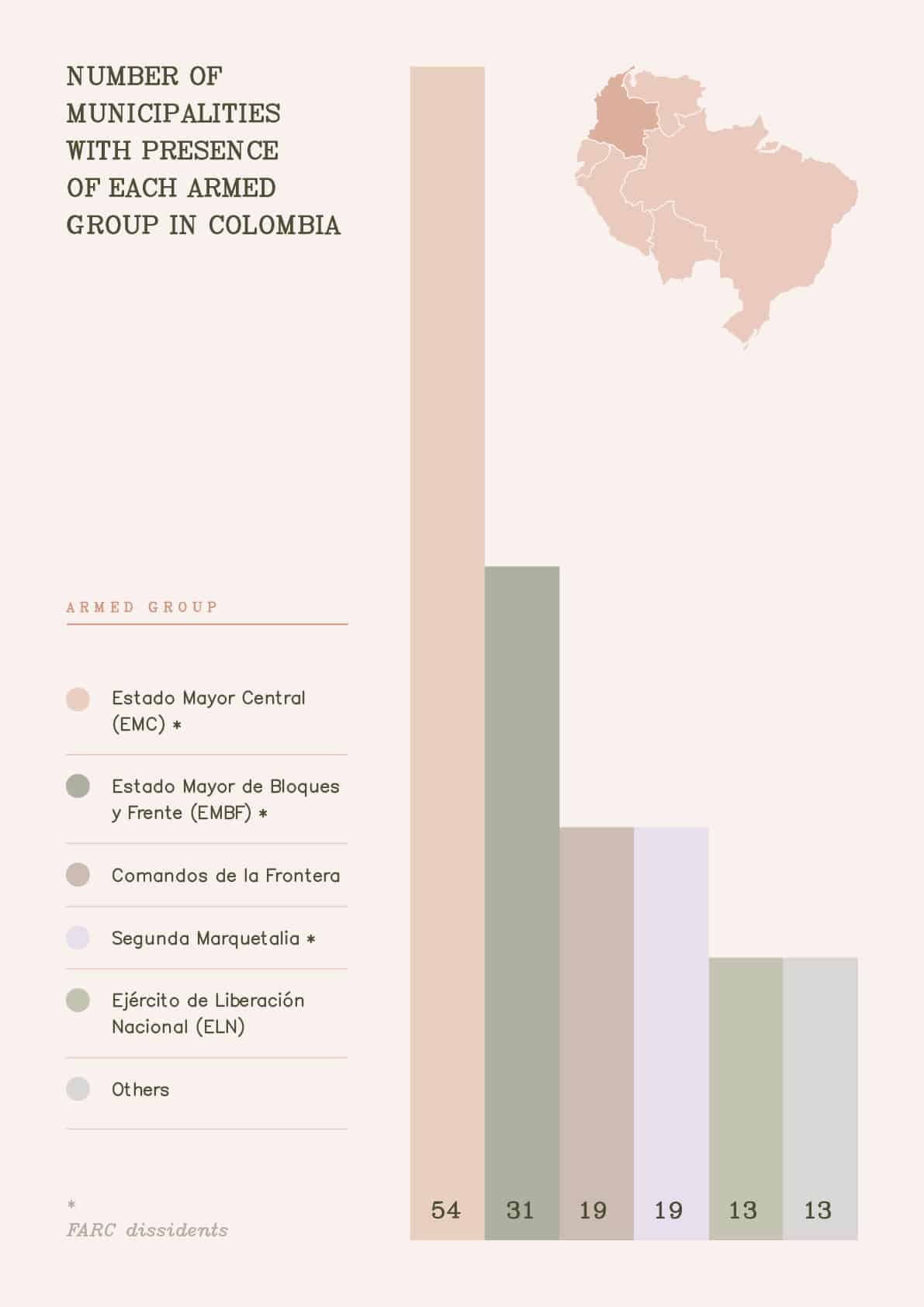
In Colombia’s spiraling conflict dynamics, the International Committee of the Red Cross stated that the humanitarian situation reached its worst point in eight years, citing intensified hostilities and diminished respect for international humanitarian law. The Geneva-based organization recognizes eight armed conflicts in Colombia, including between the state and groups operating in the Amazon, such as the ELN and FARC dissident organizations, and between armed groups, such as the Comandos de la Frontera and FARC dissident groups.
Conflict dynamics severely impact local communities, who are increasingly targeted by non-state armed groups that see them either as a source of income via extortion and forced taxation, as occurs in guerrilla-controlled areas in Guaviare and Caquetá, as human shields, as seen in El Retorno (Guaviare), or as a base for political legitimization. Increasingly, community councils and ethnic leadership face pressures, co-optation and threats to adhere to the wishes of armed groups. Communities and local businesses have been increasingly targeted for extortion payments, including cattle ranchers and communities receiving carbon credit payments from conservation projects.
The UN Office for the Coordination of Humanitarian Affairs (OCHA) documented that 9.3 million people in Colombia live in areas under armed group influence or control. Since the 2016 peace agreement, more than 1.4 million people have faced forced confinement, meaning they cannot leave their community perimeter to access essentials like food or medicines due to conflict dynamics such as ongoing violence and landmines. Forced displacement also occurs as individual “drop-by-drop” displacement, where people leave gradually rather than in mass exoduses. Land mines and recruitment of minors—sometimes at gunpoint—are common practices. For the first time in eight years, confinement, mobility restrictions and explosive devices were documented in the department of Amazonas.
For many armed groups in Colombia today, challenging state authority or seizing political control is no longer the priority—they are in it for the business.
Their focus is expanding territorial control, recruiting fighters, and building economic power. This means their operations can extend across Amazon borders, which is happening throughout the region.
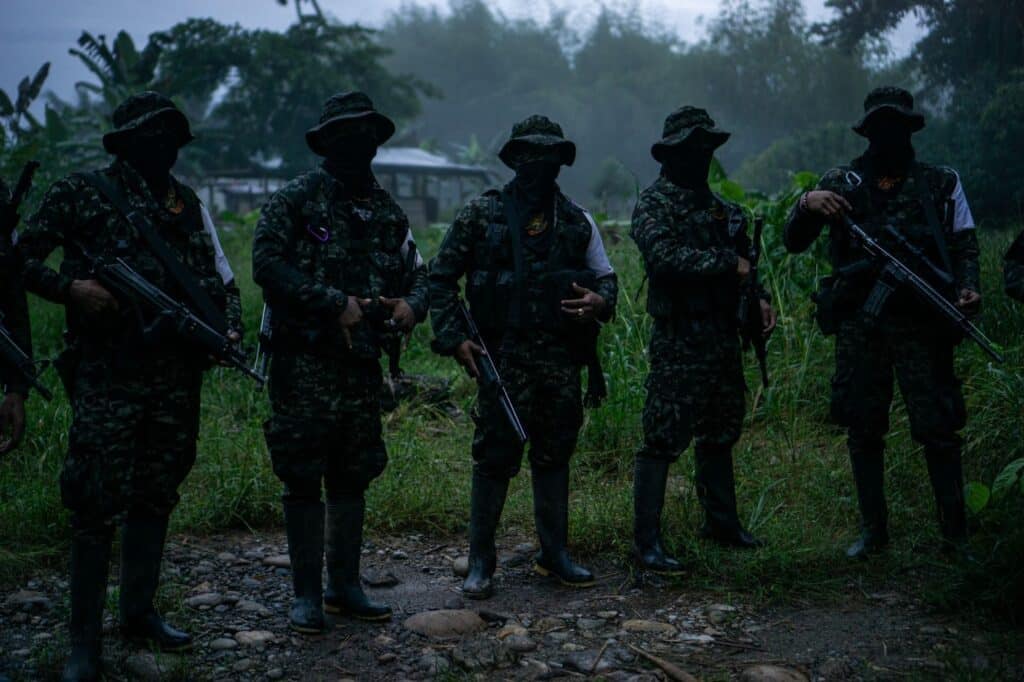
To the south, Comandos de la Frontera expanded into Ecuador and Peru, where it manages drug labs, training camps, and operates corridors toward Pacific port cities such as Guayaquil, and toward Brazil, a main consumer market and transit hub to Europe and West Africa. Amazon drug corridors gained importance due to increased seizures and surveillance on direct routes from Latin America toward Europe. In Ecuador, the Comandos de la Frontera teamed up with Los Lobos, controlling illegal gold mining areas, while Los Choneros violently incurred into southern Putumayo, Colombia to acquire cocaine base paste. In Peru, the Comandos de la Frontera extended up to the city of Iquitos and further into areas neighboring Brazil, such as Mariscal Ramón Castilla, where Comando Vermelho, the in Rio de Janeiro originated crime group also holds a presence.
Brazilian crime expansions
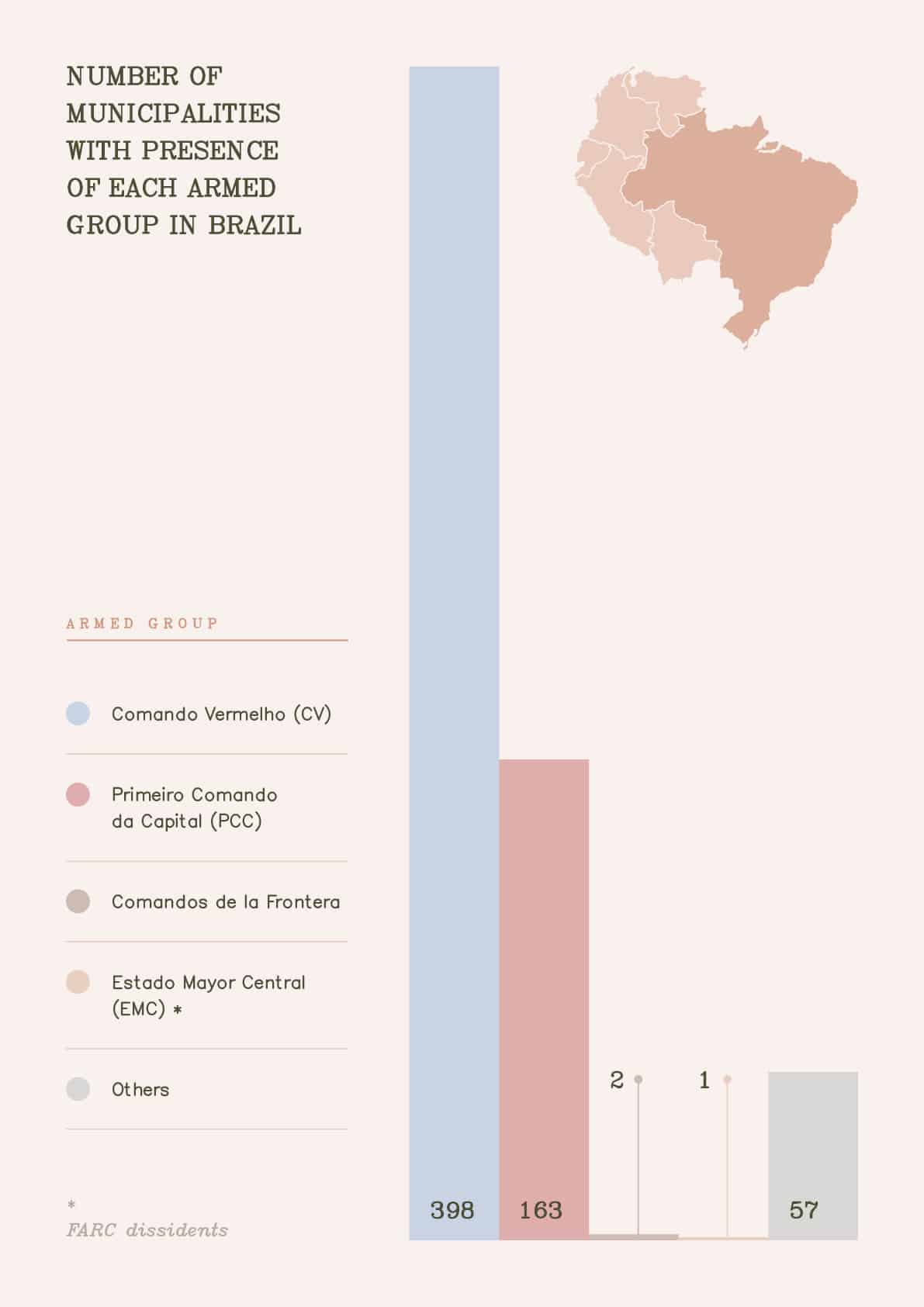
Criminal control in Brazil’s Amazon has undergone significant transformation over the past decade and a half. In the Brazilian state of Amazonas, initially dominated by the Manaus-based Família do Norte, which established strong connections with Colombian guerrillas and Peruvian coca producers around 2010, the region descended into violence when the non-aggression pact between major Brazilian crime groups Comando Vermelho and Primeiro Comando da Capital (PCC) collapsed in 2016. Following Família do Norte’s disintegration in subsequent years, many members joined Comando Vermelho to form CV-AM (Comando Vermelho’s Amazonas chapter), while others founded a splinter group called Os Crías in the border town of Tabatinga, backed by PCC financing and weapons.
403
Municipalities across the Amazon have a COMANDO VERMELHO presence. Beyond Brazil, the group also operates in Peru and Bolivia.
165
Municipalities across the Amazon have a PCC presence. Beyond Brazil, the group also operates in Bolivia.
95
Municipalities of the Amazon have the presence of both Brazilian groups: PCC AND COMANDO VERMELHO
The death of Os Crías leader Brendo in 2023 marked the end of their rapid expansion and solidified CV-AM’s dominance across the tri-frontier region. CV-AM now operates a sophisticated network spanning Brazil, Colombia, and Peru, maintaining a presence in prisons in Tabatinga and Leticia while managing coca production and trafficking routes across these territories. Comando Vermelho successfully entered areas of coca production and cocaine fabrication in Peru’s Loreto, Ucayali and Madre de Dios regions, thereby controlling several critical links in the cocaine supply chain.
Simultaneously, São Paulo’s PCC has expanded operations beyond traditional territories by seizing control of the ‘Rota Caipira’—a major trafficking corridor for Bolivian cocaine and Paraguayan marijuana. Bolivia serves as a key expansion point for PCC’s international campaign because it’s a major cocaine producer lacking sea access, making PCC’s transportation network to the Santos port strategically valuable. The route transports cocaine produced in Bolivia through Mato Grosso do Sul to ports like Santos (in São Paulo state’s coast) for export to European, African and North American markets. PCC gained control after the 2016 assassination of Jorge Rafaat Toumani, known as the “king of the frontier”, who had been the intermediary between PCC and local groups.
Comando Vermelho successfully entered areas of coca production and cocaine fabrication in Peru; PCC has diversified into mining operations in Roraima, particularly in Yanomami Indigenous lands bordering Venezuela.
Beyond trafficking routes, PCC has diversified into mining operations in Roraima, particularly in Yanomami Indigenous lands bordering Venezuela. There, the organization reportedly recruits Venezuelan migrants to work in mining sites and related activities, including security and sex work. This expansion reflects PCC’s broader internationalization, with over 600 active members in Venezuela, around 150 in Bolivia and operations extending into the Guianas.
Both criminal organizations have transformed Brazilian ports into critical transit hubs for international drug trafficking. PCC has become essential in supplying Europe’s cocaine market valued at over €11 billion, while Brazil serves as the departure point for 70% of cocaine seized in Africa and 46% seized in Asia between 2015-2021, which likely has increased. In the Amazon specifically, the largest cocaine shipment ever intercepted in a Brazilian port occurred at Vila do Conde, in Barcarena, near Belém. Meanwhile, Manaus serves as a major transit point where drugs arrive via the Solimões River and flow along the Amazon River for domestic distribution or international shipping. Both CV and PCC maintain significant presence in Belém and Manaus, facilitating these operations.
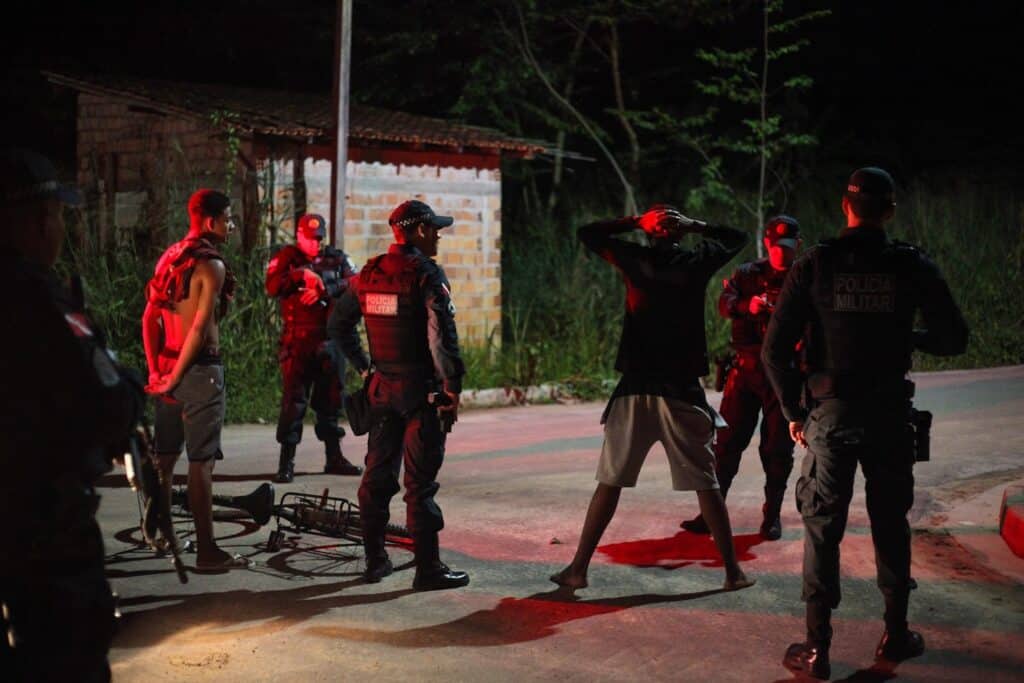
These extensive trafficking networks exploit systemic vulnerabilities in Brazil’s port infrastructure, including privately managed export facilities where cargo can be stored for months, creating opportunities for corruption. A recent law enforcement investigation revealed PCC’s deep penetration of the private sector, including the financial sector and a vertically integrated fuel supply chain. The São Paulo organization has been designated by the U.S. Treasury for its role in the global drug trade, collaborating with European criminal organizations including the ’Ndrangheta. Their operations primarily target Belgium, Spain and the Netherlands as European entry points, using sophisticated concealment methods to transport massive quantities of cocaine through Brazil’s extensive port system.
Venezuela’s Amazon anarchy
Venezuela’s regions south of the Orinoco River represent one of the greatest security challenges in the Amazon. State forces openly collaborate with non-state armed groups, including foreign actors, while pillaging high-biodiversity areas for natural resources. Colombian guerrilla organizations have established a more overt presence throughout the states of Amazonas, Bolívar and Delta Amacuro. The ELN and Segunda Marquetalia operated in a territorial alliance, dividing territory and coordinating their involvement in illicit economies.
Illegal mining of both gold and critical minerals occurs—including those needed for necessary technology for the energy transition—in all three states, using similar routes for drug and weapons trafficking. While coca is mostly grown and processed in Colombia, laboratories, stash houses and small plantations are also reported in Amazonas state. This territory facilitates movements toward Brazil over the Río Negro, departures from dozens of clandestine airstrips near the Colombian border, or routes over the Orinoco River—a main supply route to semi-submersibles that transport cocaine to the open sea before transferring to container ships on global trade routes, mainly toward West Africa and Europe. The scope of Colombian guerrilla presence and control over the Orinoco route is evident through ELN and FARC dissident presence in Delta Amacuro, extending to the Orinoco’s mouth.
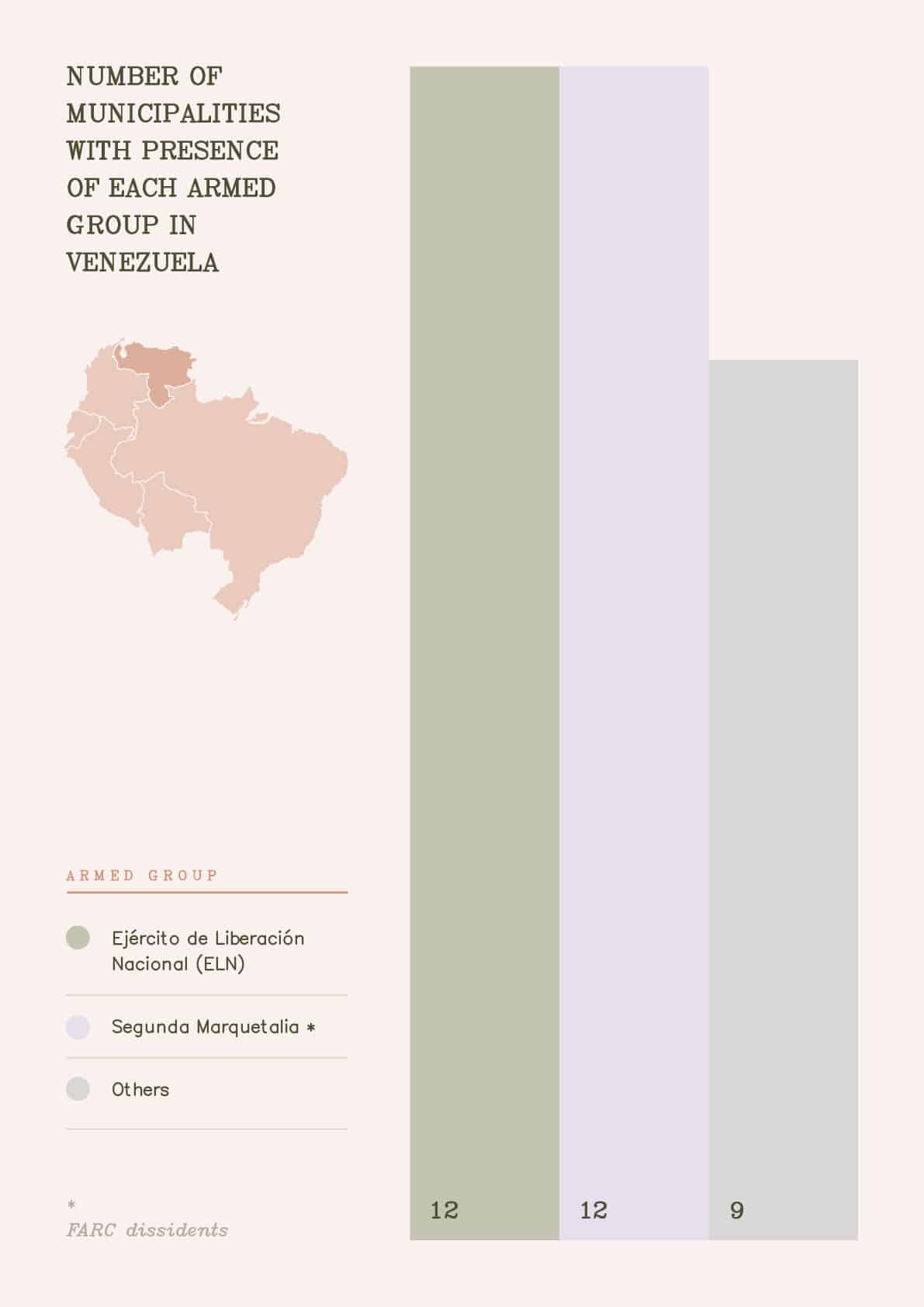
In early August 2025, the ELN-Segunda Marquetalia alliance ended abruptly when the ELN ambushed leadership of the Acacio Medina front operating in Amazonas state, triggering a series of skirmishes in the border area with Colombia. The ELN has been attempting to overtake territories with Segunda Marquetalia presence in their push for total control of the Colombian-Venezuelan border, allegedly with tacit approval from Caracas. For many years, both organizations have operated in coordination with state forces, jointly controlling illegal gold mines and drug trafficking revenue. In Bolívar state, local crime groups known as sistemas (previously called sindicatos) emerged from prisons and trade unions, especially in construction. These groups engage in weapons trafficking, drug trafficking, extortion, sexual exploitation and illegal gold mining. The sistemas operate as independent organizations—for example Tren de Guayana in El Callao or 3R in Tumeremo municipality—with sporadic incursions into Guyana. Several firefights with Guyanese state troops on the border river Cuyuní have increased tensions between both countries.
Ecuador, Bolivia and Perú: local crime
Historically, Ecuador, Bolivia, and Peru have differed from previously discussed countries in that local crime groups have dominated the criminal landscape rather than larger non-state armed groups or crime syndicates. However, this is changing as foreign groups increasingly expand their footprint through territorial takeovers and violent competition with local organizations.
Local crime groups, such as Los Guardianes de la Trocha in Peru and Los Villanos del Tahuamanu in Bolivia, have been categorized under the designation ‘others’. This traditional dominance by local actors is now under pressure: smaller family-clan based Peruvian groups have seen their territories invaded by larger foreign criminal structures, while Brazilian gangs have expanded into Bolivia.
Drug trafficking operates across all Amazon departments of Bolivia, particularly in border areas with Brazil and Peru. Brazil’s PCC has established confirmed operations in Bolivia, especially in Santa Cruz.
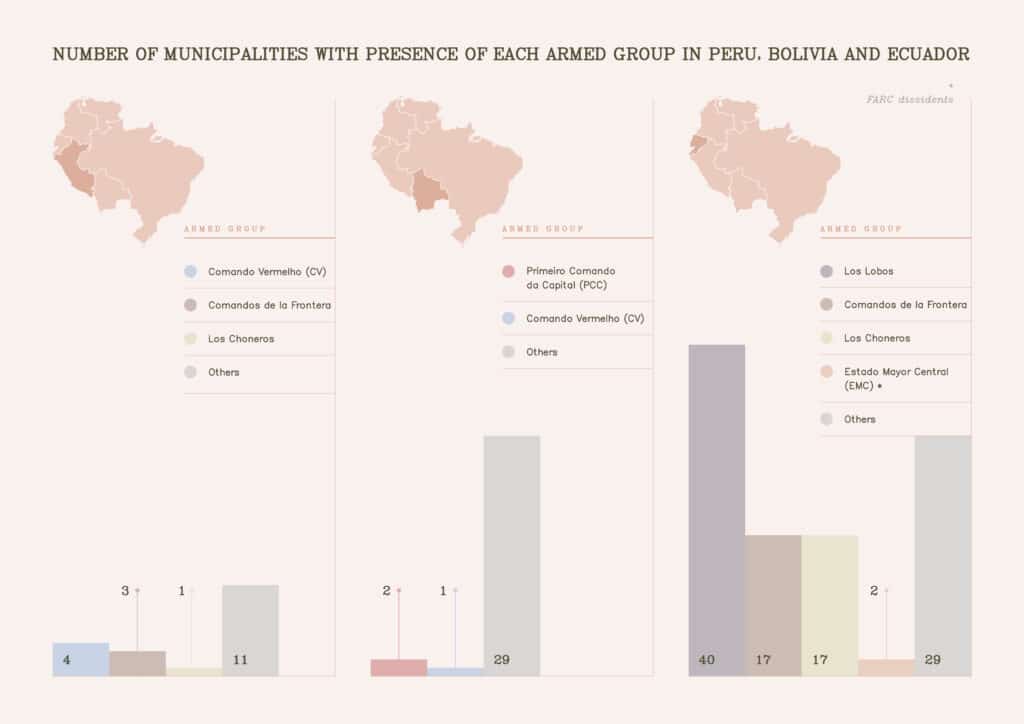
These criminal networks exploit state abscense at borders to smuggle drugs and natural resources—timber, wildlife, wild fruits and gold—to markets in the United States, China the Middle East and Europe. Illegal mining flourishes unchecked in Bolivia’s northern Amazon through barges run by Chinese or Colombian operators, working with local cooperativesWith authorities avoiding these zones entirely, criminal groups traffic timber and land, and cultivate coca in protected areas with complete impunity, leaving populations defenseless.
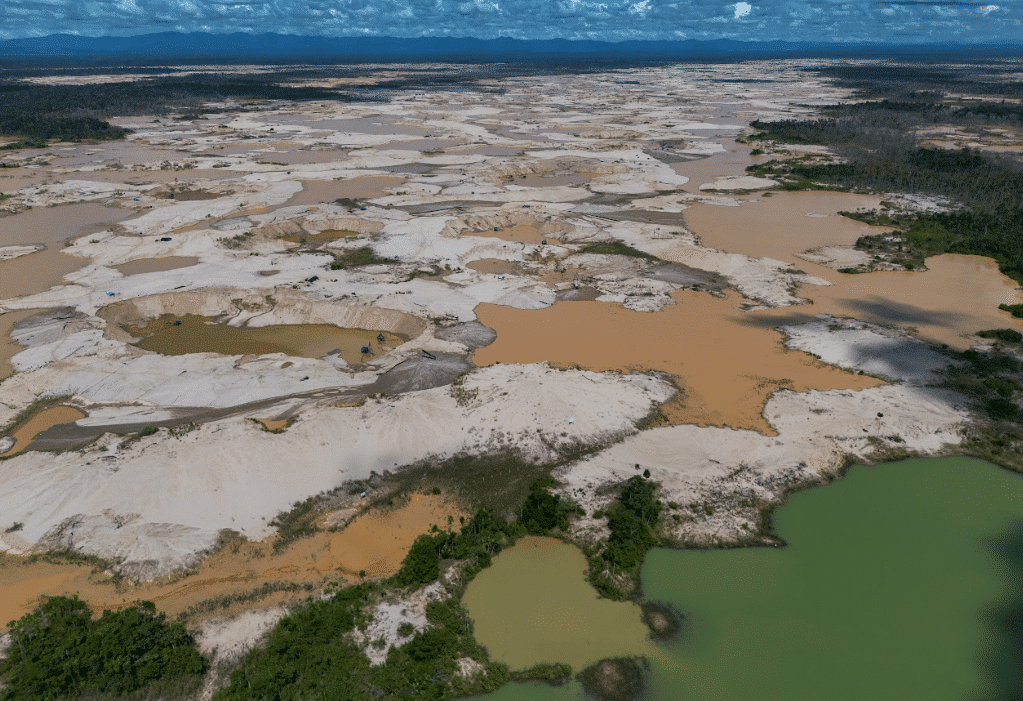
In Peru, illegal gold mining continues unabated in Madre de Dios while expanding in Loreto—both border areas. Coca crops have increased in these regions and in Ucayali, which is also rife with illegal timber extraction where Indigenous leaders have been violently targeted by crime networks. CV and local crime outfits are present in both regions.
Ecuador faces one of the most severe escalations in violence and the disintegration of security. Since Colombia’s 2016 FARC peace negotiations, armed group fragmentation has strengthened FARC dissident presence in departments bordering Ecuador, reinforcing cocaine transit routes southward to Ecuadorian exit ports servicing U.S. and European markets. Colombian groups consolidated these trafficking corridors by partnering with Ecuadorian gangs like Los Choneros, fishers and local traffickers, while infiltrating state institutions to corrupt customs officials, justice operators, and local politicians.
Ecuador’s prison-born gangs have expanded into Amazon regions as the security crisis escalated during the pandemic. Los Lobos shifted focus to controlling cocaine supply chains and expanding into illegal gold production areas, now operating in Napo, Orellana, and Sucumbíos provinces. Meanwhile, Los Choneros—which originated in coastal Manabí in the 1990s—have entered Peru via the disputed Santiago River, targeting areas where illegal gold mining barges operate.
In Ecuador, a pivotal shift occurred in 2018-2019 with the discovery of substantial gold deposits in La Merced de Buenos Aires, northern Ecuador, attracting hundreds of illegal miners, including Venezuelan migrants, Colombians and locals. When authorities dismantled this operation in 2019 without a long-term strategy, miners dispersed to the northern Amazon, particularly Napo province.
5x
is the HOMICIDE RATE INCREASE in the Ecuadorian Amazon in four years.
This displacement dramatically altered criminal dynamics. Los Lobos capitalized on the miner influx, identifying gold mining as a highly profitable financing source and expanding throughout the Amazon through extortion schemes. Between 2023 and 2024, their alliance with Colombian armed group Comandos de la Frontera in border provinces has involved assassinating suspected Los Choneros members to gain local support by providing security rackets. In the Amazon provinces of Napo, Sucumbios and Orellana, homicide rates increased from 10 per 100,000 inhabitants in 2021 to above 50 in 2024.
The implications are severe and wide-ranging. Violence and insecurity have surged as local authorities lack capacity to confront criminal operations, while corruption infiltrates institutions, authorities and communities. The social impact proves particularly devastating, with criminal groups invading indigenous and rural territories and coercing participation in illicit activities that violate traditional practices. Environmental destruction compounds these problems, as mercury and toxic contamination from illegal mining poisons water sources, flora, fauna and public health, creating lasting damage for local communities and the broader Amazon ecosystem.
Conclusion
The Amazon’s fragmented criminal ecosystem, characterized by few areas under hegemonic control, has entered an era of heightened violence driven by peak gold prices and surging global cocaine demand. This convergence makes the Amazon one of the world’s most crime-ridden and violent regions. Alliances between organized crime groups remain volatile and temporary, while territorial disputes over trafficking corridors, drug markets and production areas catalyze violence across rural and urban Amazon territories.
From transnational crime syndicates to local gangs, these networks operate global drug trafficking and gold mining businesses. Those seeking complementary income or excluded from major illicit economies increasingly turn to extortion, affecting local populations particularly in Colombia and Ecuador. Meanwhile, emerging economies—including attempts to green transition practices such as taxing carbon credits or mining transition minerals—are beginning to reshape the criminal landscape.
Violence extends beyond rival organizations and state forces to torment Amazon communities, who face forced displacement, confinement and violent coercion as they are instrumentalized to serve criminal agendas.
These crimes exhibit a transnational character through cross-border movements of goods, weapons, people and money—though direct swaps, such as cocaine for weapons, are common. Environmental impacts, including oil spills, mercury-contaminated fish and forest fires, also cross international borders, requiring regional state responses that match the scope of crime networks and address transnational threats.
Crime groups’ growing capacity to infiltrate formal economies—especially for money laundering through land grabbing, cattle ranching and industrial agriculture investments—makes them increasingly difficult to combat, particularly when criminal tentacles extend to local authorities and state institutions.
Crime groups’ growing capacity to infiltrate formal economies
makes them increasingly difficult to combat
particularly when criminal tentacles extend to local authorities and state institutions.
On the front lines of environmental and cultural defence stand local Amazon communities—Indigenous, Afro-descendant, campesino and other traditional populations—often safeguarding vast rainforest territories through monitoring and guard groups. This makes them primary targets for criminal organizations, especially where state presence is weakest or law enforcement has been compromised.
Ultimately, as long as criminal revenues continue to corrupt state forces, judges and local Amazon authorities, corruption remains one of the main impediments to effective conservation and security strategies throughout the Amazon basin.
In 2026, the region will face a fierce test. After two consecutive environmental and climate conferences in the region—the Biodiversity COP16 in Colombia (2024) and the Climate COP30 in Brazil (2025)—international attention might fade. Meanwhile, elections in the three main Amazon economies—Brazil, Colombia and Peru—might reshape the region and attitudes toward nature conservation, cultural preservation and climate goals.
Research
Bolivia: Amazon Underworld
Brazil: Leandro Barbosa, Adriana Amâncio and Isabel Lima
Colombia: Bram Ebus, Daniela Castro and Juanita Vélez
Ecuador: Diego Cazar Baquero and Paúl Mena
Peru: Pamela Huerta, Alonso Marín Jiménez and José Luis Huacles
Venezuela: Bram Ebus and María Ramírez.
Infographics
Laura Alcina
Maps
Natalie Barusso