The Peruvian Amazon faces not only illegal logging, gold extracted from rivers, and expanding coca crops. At the root of all these problems lies the relationship between mayors, governors, their personal interests, and organized crime. From their positions of power, they facilitate concessions to family members, ignore environmental laws, and let the jungle pay the price with razed forests, contaminated rivers, and displaced communities. Madre de Dios reflects a larger pattern: there, gold wealth and social precarity coexist with authorities who defend private businesses while transnational gangs impose their law and gold flows to international markets, leaving behind an endless cycle of violence and devastation.
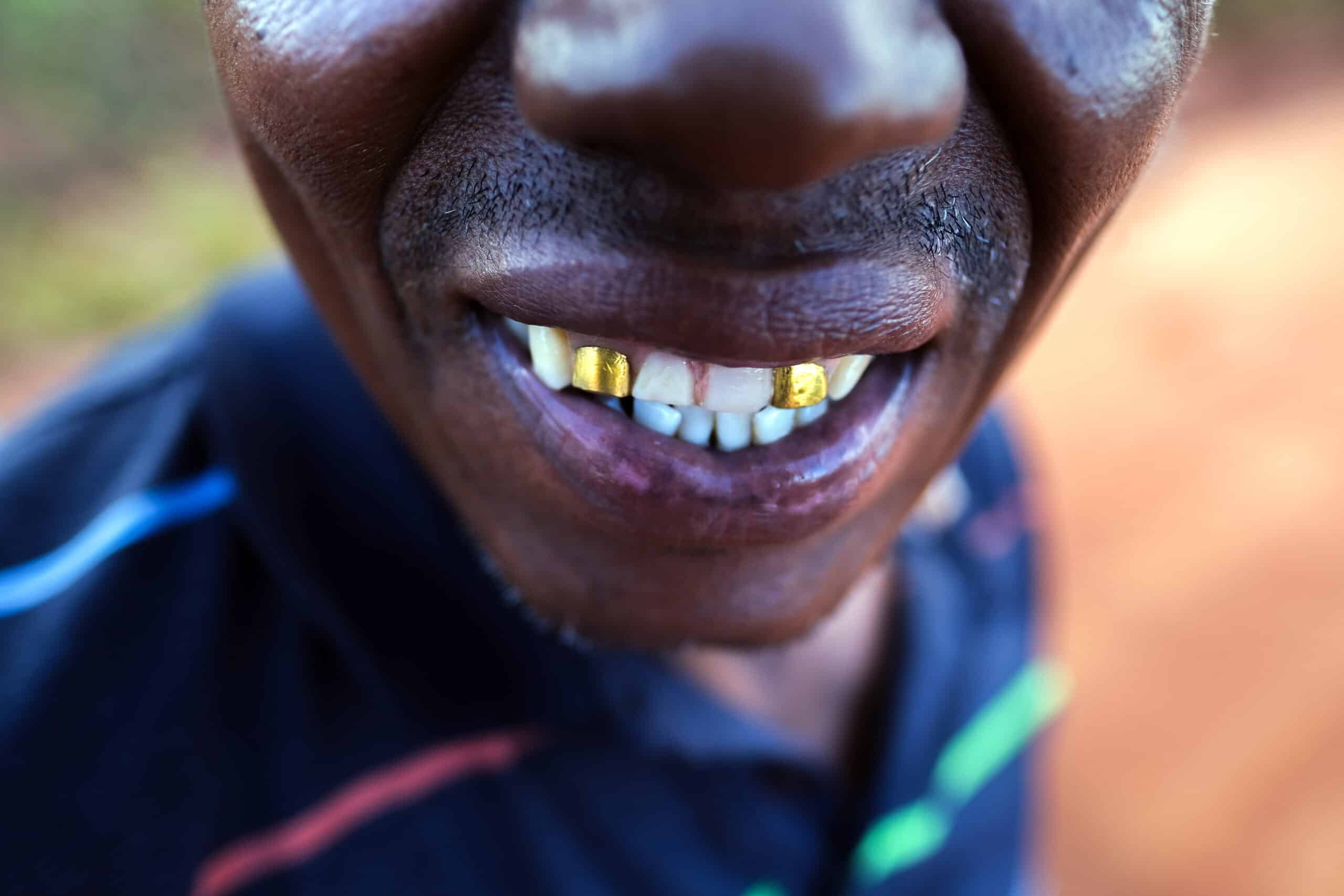
In Puerto Maldonado, the capital city of Madre de Dios, the heat offers no respite as the streets sizzle and the humidity suffocates. In the office of regional governor Luis Otsuka Salazar, the air conditioner hums, white leather sofas gleam, and a gold ring glimmers on his hand — the kind he’s forbidden by law to extract from the region’s rivers and streams. The scene captures the province’s central contradiction: a public official enriched by the very industry he is meant to regulate.
Otsuka doesn’t hide his dual role. He is both governor and miner. “I started working with gold when I was 10 years old,” he recalls. What he omits is that alluvial mining on water bodies—the only kind possible in Madre de Dios—is prohibited. His defense of the business is unabashed, and his reasoning exposes a deeper truth: when enforcers become participants, the law exists only on paper.
Environmental crimes in the Peruvian Amazon are closely linked to corruption, which permeates all levels of government. The financial muscle, bolstered by drug trafficking income and powered by illegal gold extraction, buys all kinds of complicity. It leads the officials charged with supervising environmental safeguards to look the other way. It enables regulators to provide documentation that legalizes products of illicit origin. It allows elected politicians to buy the votes needed to stay in power.
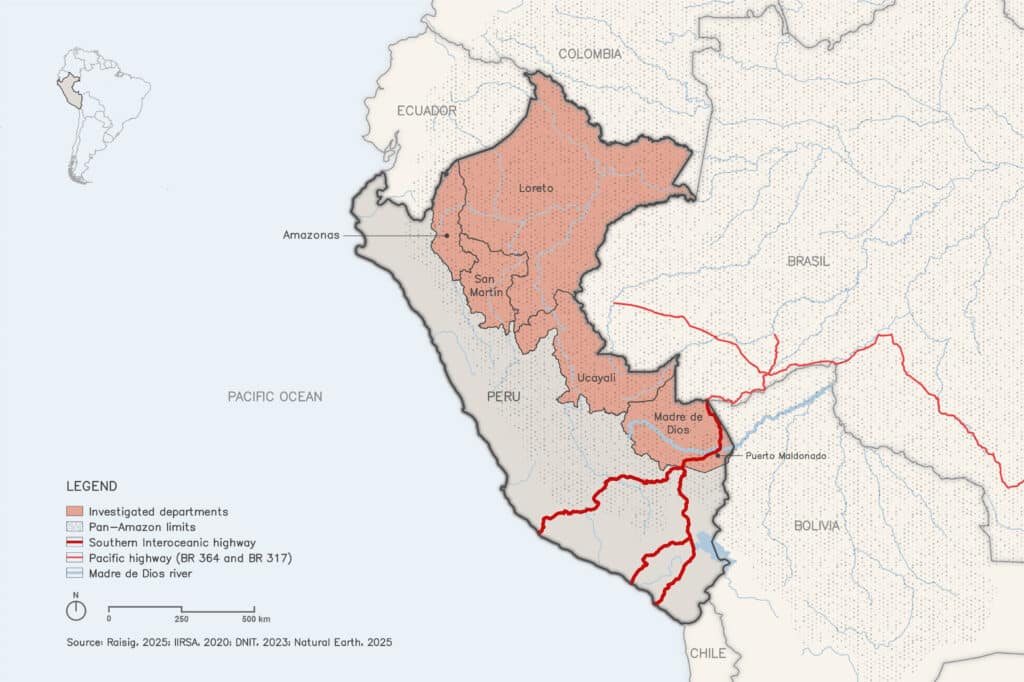
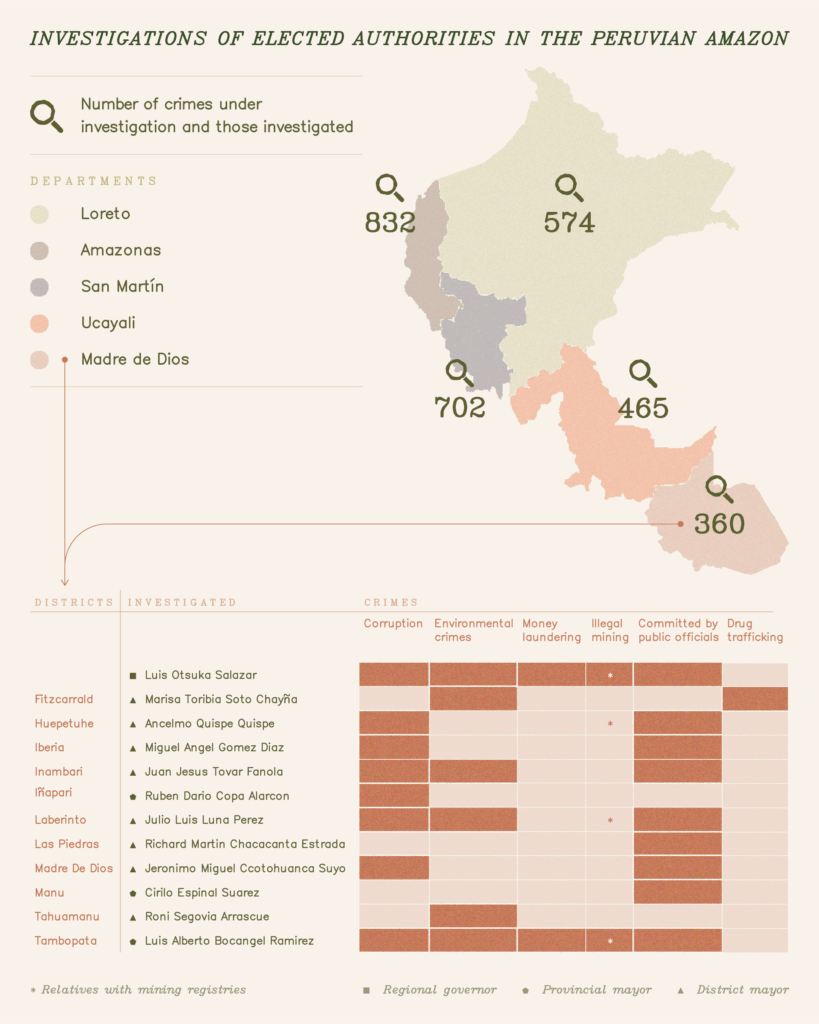
In Peru’s five Amazonian regions — Amazonas, Madre de Dios, San Martín, Loreto, and Ucayali — 200 of 250 locally elected officials have been investigated by the Public Prosecutor’s Office, records reviewed by Amazon Underworld show. Together, the cases cover nearly 3,000 alleged crimes — most for abuse of public office, followed by property, environmental, and money laundering offenses — revealing how deeply corruption has taken root in local government.
Alarming numbers that make clear that the dispute over Peruvian Amazon resources also includes people in popularly elected positions. For this reason, Al Margen, our journalistic ally in Peru, created a freely accessible database and developed a search tool that shows the complaints filed against these officials and relevant data: number of lawsuits, case numbers, and current status of accusations.
Amazonas is the region with the highest number of investigations into locally elected authorities, with 832 currently pending, followed by San Martín (702), Loreto (574), Ucayali (465), and Madre de Dios (360).
The latter is a gold-rich jungle region bordering Brazil, cut open by the Interoceanic Highway. This area exemplifies how corruption not only enables environmental crimes but also facilitates violent international criminal groups establishing their operations and dictating daily life.
REFLECTION OF THE AMAZON
Madre de Dios, Peru’s most biodiverse department, typifies a broader Amazonian trend: officials who shift from serving the public to defending private interests, and in doing so pave the way for large-scale environmental crimes.
“What is the solution? Establish clear regulations that allow for development. Do people want to formalize their businesses? Great! Why have mining concessions been banned in Madre de Dios? Why? Oh, for forest conservation? What conservation? So that these scoundrels from the NGOs can get rich? How is it possible that I am being reported for building a road because I have supposedly created a buffer zone? And there is another complaint against me, because by opening a road I am disturbing the sleep of the birds. Imagine that.”
The speaker is Luis Otsuka, regional governor of Madre de Dios and a miner since childhood. Otsuka’s case is not isolated, Madre de Dios is divided into three provinces — Tambopata, Tahuamanu, and Manu — which together comprise 11 districts. Of the 12 authorities governing the department, at least seven (60%) have ties to mining. Six appear in the Comprehensive Mining Formalization Registry (Reinfo) — either personally or through immediate family members — a temporary system created to prevent the criminalization of miners as they formalize their operations. Four hold or have held mining titles issued by the Geological, Mining and Metallurgical Institute (Ingemmet), a key requirement for engaging in formal mining.
Although many workers in alluvial mines fit the portrait of miners covered in mud and tatty clothes, they are not the ones who reap the greatest profits from the business. In this region of the Peruvian Amazon, miners wear pressed shirts and polished shoes. They are elected officials — mayors and public servants — with direct or indirect links to gold mining in their jurisdictions. People here don’t speak of illegality or informality; they use calculated language and structured arguments to defend mining “for the sake of progress and development.”
The most prominent names include regional governor Luis Otsuka; Tambopata mayor Luis Bocángel; Inambari mayor Juan Tovar; Laberinto mayor Julio Luna; Manu mayor Cirilo Espinal; Madre de Dios mayor Jerónimo Ccotohuanca; and Huepetuhe mayor Anselmo Quispe.
In many cases, it’s not just individual projects but family businesses that oversee permits and concessions as private assets. Fathers, brothers, sons, uncles, and nephews participate in administering these mining rights. Thus, political power and gold interests merge into a single mechanism. For them, the mythical Paititi and the city of gold ceased to be legend.


The magnitude of the business is gargantuan. In 2023, Madre de Dios exported US$196 million in goods, according to the Ministry of Foreign Trade and Tourism (Mincetur), of which more than 70% was gold destined for India, the United Arab Emirates, and the European Union.
Of all gold exports between 2020 and 2024 (US$555 million), more than 60% were exported by just two companies: E&M Company (US$192 million) and GoldMax’D Oro (US$154 million). Gold was also purchased by only a few companies, including Kundan Refinery Private Limited, Esteem International, Omgl Refinery Limited Liability, Esteem International Trading Fze Co, Transguard Emirates, and Arbit Commodities Dmcc. These importers promise their clients a high-purity product, refine it, and transform it into gold bars, coins, jewelry, and even frames.
This department registers one of Peru’s lowest monetary poverty indicators: only 7.7% of its population. But the figure is misleading. Multidimensional poverty reaches 43.7%: there’s money, but basic services, health, and decent education are lacking. Health centers in dire straits, the roofs of schools are falling in, and many girls are unable to dream of a normal life as they are victims of human trafficking in mining camps.
Corruption aggravates the situation. In Madre de Dios, 70% of authorities, including Otsuka, have investigations for crimes including embezzlement, abuse of power, or absence from office. Half face proceedings for environmental crimes. Otsuka and Bocangel have pending cases for illegal mining and money laundering.
In Manu province, the outlook gets darker still. The mayor of Fitzcarrald district, Mariza Soto Chaiña, is under investigation for environmental crimes and, between 2003 and 2024, accumulated at least nine investigations for drug trafficking. Soto Chaiña did not respond to a request for comment for this article.
Meanwhile, coca crops in Madre de Dios have skyrocketed from 36 hectares in 2018 to 1,476 in 2024. More than half—51%—grows in Manu, amounting to 756 hectares full of coca leaf bushes. Amid this scenario, Huepetuhe mayor Anselmo Quispe proudly displays his most emblematic project: the Huepetuhe Municipal Stadium. He says that informal miners contributed machinery and labor to enable the land where it was subsequently built: A tacit alliance between local power and the illegal economy.
THE SOUND OF LA PAMPA
Otsuka Salazar lost his father when he was still a child, and later his house in a major flood. Together with his mother and siblings, the governor recounts, he moved to high ground to start anew with an axe and machete. That misfortune, he maintains, changed his course and that of his family. “The flood had deposited a large amount of gold (on the banks) and my mother was given two square meters on a small beach to work. That’s how I started with gold, with shovel and wheelbarrow,” he recalls sorrowfully. Today, he has gone from extreme poverty to a declared income of more than 1.500.000 soles annually, around US$ 500.000.
Otsuka doesn’t hide his history or his current position on the matter; on the contrary, he denounces the regulations that prohibit gold mining on water bodies. “What do you think Peru lives on? It lives on mining,” he says, raising his voice. “But there’s a regulation, Legislative Decree 1100, that prohibits mining in rivers, streams, lakes, swamps… So where are they going to mine?” he complains.
The contradiction is evident: the same laws that require them to protect the environment—the Regional Governments Organic Law, the Municipalities Organic Law, and the General Environmental Law—collide with their private interests.


Temperatures approach 30 degrees Celsius and in Puerto Maldonado, Madre de Dios’s capital city, and the streets burn like coals. No one is in sight. When night falls, the situation reverses. Restaurants open, shops awaken, and vibrations to the rhythm of cumbias and huaynos thunder in bars: Andean singer Yarita Lizeth is the current artist in fashion.
But just an hour from the city, from kilometer 98 to 115 on the South Interoceanic Highway that connects Peru with Brazil, these sounds transform into an unbearable onomatopoeia: taca-taca-taca-taca-taca… It’s the announcement that you’re in La Pampa, a settlement of about 40,000 inhabitants that resembles a large war camp. Wherever you look, behind raffia modules, there are extensive territories of deforested forest and disturbed lands.
The trenches are pits where workers operating dredges sink, like a young man who asked to be referred to as only Lorenzo* for security reasons. He arrived from the western city of Ica at age 16 to work operating heavy machinery in an informal mine. He says he worked 12-hour days without breaks for 1,500 soles a month (about $415) in Huepetuhe — a key site in Peru’s only authorized alluvial mining zone, created by Emergency Decree 012-2010 to make mining regulation in Madre de Dios a national priority.
“Here rest is unknown, you come to make your little money to be able to progress, I have to pay bank loans I took out to help my family. That’s why I came when they offered me the job. Later I arrived at La Pampa because here I earn daily, for what I extract in my shift, it’s not fixed like on the other side,” Lorenzo* details while resting sitting on a dirty tube as a seat. “For those who say easy money is here, they should come, let’s see if they can handle it,” he adds.
However, illegal mining doesn’t just devour the jungle — it sustains a cycle of violence that seems without end. Control of the camps lies in the hands of criminal groups that enforce their own laws. The Comando Vermelho (CV), a Brazilian gang with transnational reach, has expanded into this corner of the Amazon. Operating in its shadow is Los Guardianes de la Trocha (LGdT), a group the Peruvian National Police (PNP) describe as paramilitary — born in the region’s mining camps and now with armed branches in other regions such as Amazonas, Loreto, and Ucayali.


“Many of the wounded arrive with a gunshot in the palm of their hand,” says a local doctor, who requests anonymity for their security.
‘The securities’—he says, referring to CV and LGdT—punish those they accuse of theft this way. The bullets rarely get registered beyond the medical report. The police, although they receive the report, seldom investigate.
In this regard, police sources confirm that their units have little room to act because the territories are divided among external criminal actors and they lack the necessary resources to confront them.
In La Pampa — the epicenter of illegal mining — Lorenzo* offers a different account. He recites by heart the fees that keep the gold economy running. Each dredge, he explains, pays two: 500 soles a month to los seguros — a territorial control system run by CV and LGdT — and 1,000 soles a week to the Environmental Police to ensure their machinery isn’t destroyed. According to testimonies, this arrangement lasted until August 3, 2025, when a police order withdrew the Environmental Police from all their bases in Madre de Dios to rethink operations against environmental crimes. As of press time, the agency had not responded to any of our questions on the matter.
A joint operation was carried out weeks later, between August 20 and 25, with the involvement of the Environmental Prosecutor’s Office (FEMA), the PNP, and the Army. In this intervention, according to official reports, around seven engines, eight rafts, three cargo motorboats, four linear motorcycles, were destroyed. We requested a formal interview from the Environmental Directorate of Peru’s National Police (PNP), but had not received a response at the time of publication.
As extortion and violence shape daily life in Madre de Dios, local authorities focus on another goal — rewriting the law to permit alluvial mining in water bodies.
Manu provincial mayor Cirilo Espinal says it without hesitation: “If they mine in other countries, why are they going to prohibit us here? If the corridor is laid out and nobody leaves it… the government should support it as soon as possible.”
For Germán Fernández Hanco, an environmental defender recognized by the Justice Ministry’s (Minjus) protection mechanism, the dispute is not just legal, but about a way of life. “We had cows, milk, cheese, chickens… everything green. A clear stream where we fished, learned to swim. It was beautiful,” he recalls.
On March 20, 2022, Germán lost his brother, murdered while trying to stop illegal miners invading his family’s territory. His parents had arrived in the 70s from Sicuani, Cusco, and were one of the founding families of Nuevo Arequipa, a story he tells with pride and the pain of loss.
The South Interoceanic Highway, inaugurated in 2010, consolidated the upheaval. The road linking Peru and Brazil brought a constant flow of illegal miners and merchants. The green fields of Germán’s childhood were replaced by pits, debris, and deforested strips. “We lived precariously, but we were happy. When the construction began, the robberies also started. They took our car axles, the animals. Everything changed,” Germán says.
That change went far beyond an adjustment to the way of life. It opened the way to a broken landscape, where the roar of engines, mercury, and armed threats replaced birdsong and the clean shine of rivers.


In gold mining, the metal is extracted by dredging riverbeds to remove sediment that contains trace amounts of gold. The method can be artisanal or mechanized, though today mechanized dredging dominates — especially among illegal operators. The collected sediment is then taken to processing areas, where the gold is separated and amalgamated with mercury — the only heavy metal that is liquid at room temperature.
In Peru, mercury use is regulated by the Ministry of Environment (MINAM), the Ministry of Energy and Mines (MINEM), and the National Superintendence of Customs and Tax Administration (SUNAT). In Madre de Dios, however, it’s as easy as walking into a hardware store. A 100-gram vial — about enough to fill a soda bottle cap — sells for 300 to 350 soles ($84–97).
After the high-temperature process, the gold is free of impurities and becomes a piece of the planet’s most coveted metal and as such a globally fungible commodity. Intensive mining accelerates in months, a process that takes nature centuries. Achieving that shine has a lethal cost.
Between 2018 and 2022, Julissa Estrada, project coordinator at the Water Technology and Research Center (UTEC), led a study measuring the impact of gold mining on Amazonian rivers, with a focus on Madre de Dios. Using satellite imagery and hydrogeomorphological analysis, the team identified a turning point: between 1984 and 1995, the impact was minimal, but from 2008 onward — and especially between 2010 and 2020 — deforestation surged.
Areas like Huepetuhe or Caichigüe ceased being winding, living rivers and became patches of water trapped in pools and islands. “In many cases we could no longer measure parameters, because the river had lost its natural form,” Estrada recounts. Lateral displacement, erosion, and channel alteration have advanced at unprecedented speed.
Mercury, naturally present in Amazonian soils, is released massively when the bed and banks of the river are disturbed. The highest concentrations travel with fine sediments — clays and silts — that cloud the water. Although artisanal miners often recover mercury because of its cost, large-scale land removal releases what has been trapped in the soil for centuries.
The metal seeps into the river system, binding to fish and embedding itself in the food chain. “It’s not just what they use, it’s what they release by disturbing the soil. And in heavy rain seasons, all that contaminated sediment washes into the river,” Estrada specifies.
The UTEC study found a serious gap. Environmental regulations measure water and soil quality but ignore the solid fraction traveling with the river. The greatest mercury load concentrates in those fine sediments, and their exclusion from official measurements, hides the magnitude of the damage. Estrada recommends including this parameter to ascertain the full scope of contamination.
In rainy seasons, the river can rise up to three meters in a day and drag tons of sediment with heavy metals, a displacement that under natural conditions would take centuries now occurs in weeks.
In 2020, the Amazon Scientific Innovation Center (CINCIA) published an alarming study. In three Matsigenka indigenous communities in Manu National Park, mercury and methylmercury concentrations in hair—measured between 2014 and 2018—exceeded WHO reference values. The carnivorous and scavenger fish analyzed also exceeded permitted levels, especially in their adult stage.
The vice president of the Native Federation of the Madre de Dios River and Tributaries (Fenamad), Eusebio Ríos Ibiche, warns that mining not only devours the forest but increases the risk that communities consume harmful fish. “Communities are affected by invasions, by the Interoceanic Highway that allows direct access to our territories. There’s no control,” he says. He adds that settlers arrive from different parts of the country and abroad. “We haven’t been able to identify them, it’s not our job, but authorities should do it,” he says.
Far from being an exception, Madre de Dios is emblematic of how governors’ economic and personal interests open the door to environmental crimes throughout the Amazon. What is expressed here in illegal gold, mercury in rivers, and armed gangs echoes in illicit economies in Loreto, Ucayali, and Amazonas. The formula is established: authorities who become partners in illegal businesses, overseers who backslide on their duty, and communities that bear the brunt of violence and pollution. The result is a perverse cycle where gold, timber, or coca yield wealth outside, while the jungle is left devastated and Amazonian peoples sacrifice their future. In this equation, the Amazon always loses, and corruption becomes the real power that dictates the region’s destiny.