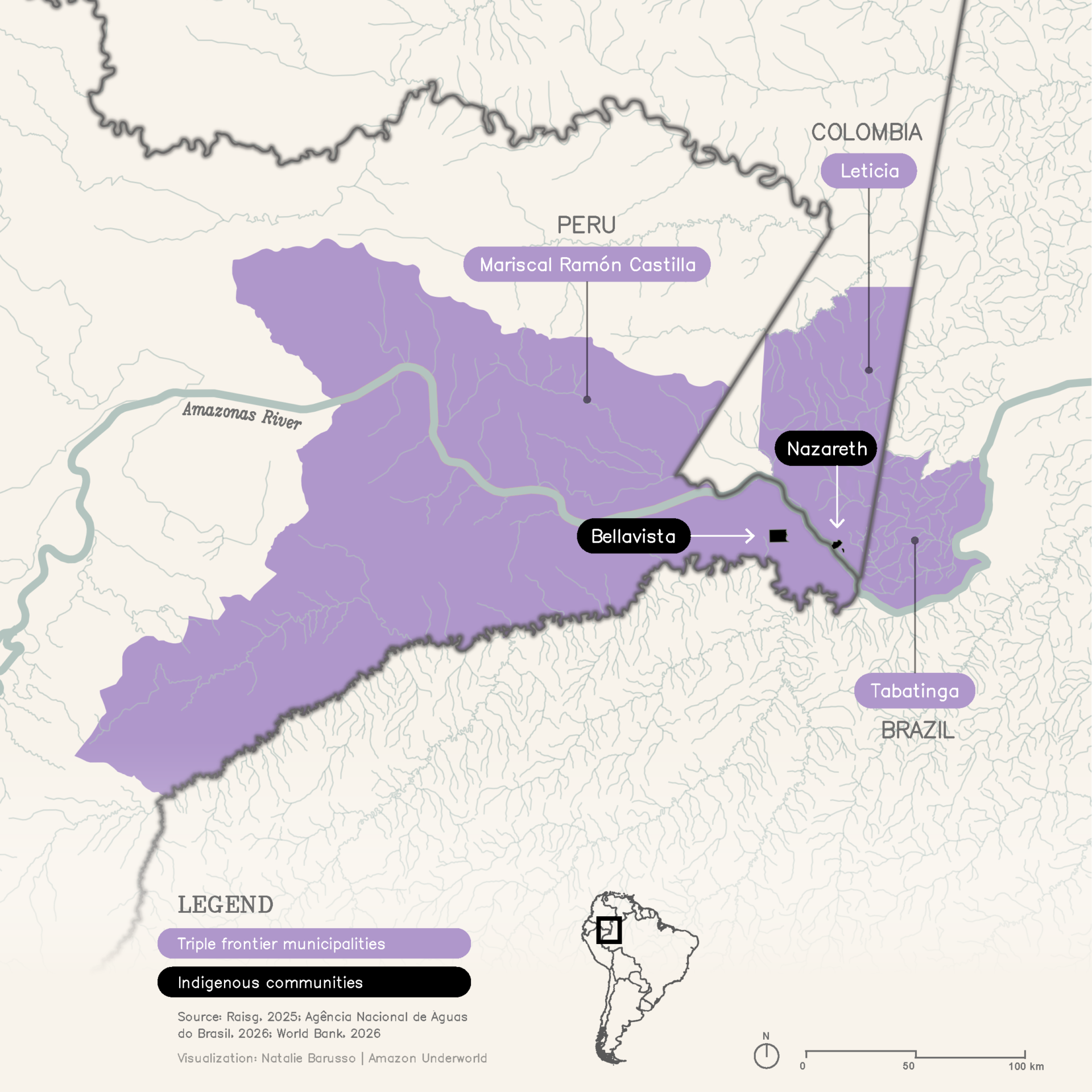
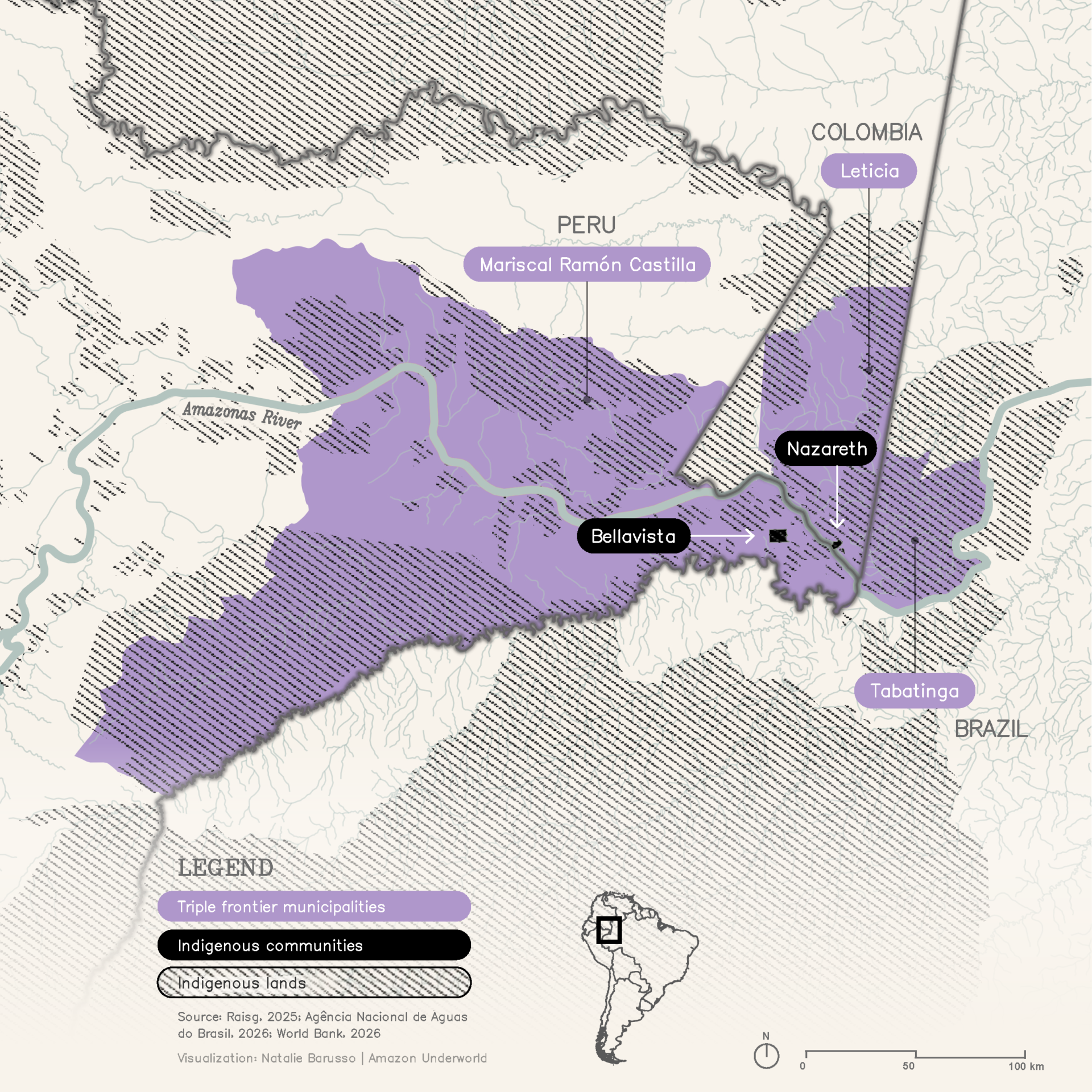
In the tri-border area between Colombia, Peru and Brazil, the steady advance of drug trafficking has turned drug use into a public health crisis, hitting Indigenous communities particularly hard. Young Tikuna and Cocama people are recruited to work the coca crops and laboratories in Peru, while others receive coca paste as payment or buy it inside their own communities, feeding a cycle of addiction, violence, and tragedy.
“Nazareth must change,” says an Indigenous leader into a microphone, in an empty hall as a yawning dog saunters by. “Nazareth must get better.”
Her voice carries through a speaker system that this Indigenous community of 1,080 people in the Colombian Amazon, home to the Tikuna and Cocama peoples, relies on for everything: dance class schedules, health campaigns, political meetings,
and grim announcements of suicides .
“I was losing my mind,” said Geni Catachunga, a health promoter in the community for the past 11 years. “ In 2020, from January to June, there was a case (of suicide) every single month, and every month we found out through that speaker.”
As Catachunga speaks, she tallies the suicides on her hand, but runs out of fingers. Twelve young people lost in recent years.
According to data from the Amazonas departmental health secretariat, suicide attempts across the region rose from 63 in 2021 to 100 in 2024, and another 100 in 2025. So far this year, 43 attempts have been recorded.
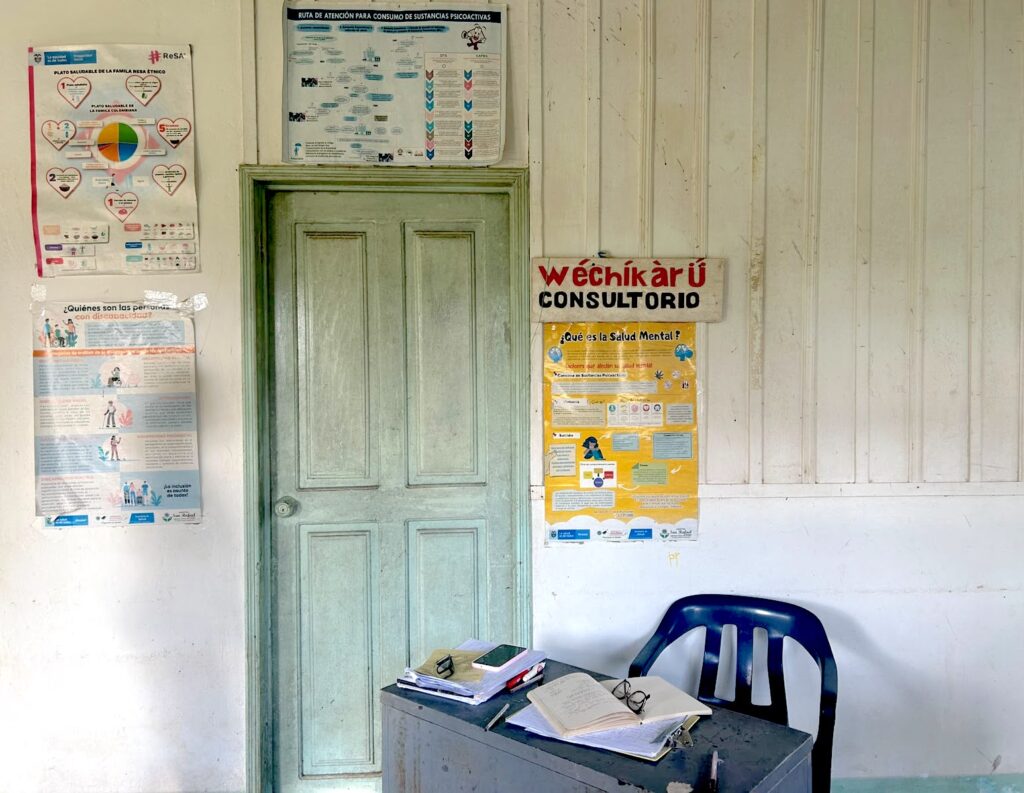
Catachunga, wearing a blue coat with her black hair tied back, explains that young people have little to busy themselves with, and sometimes lack support from their parents. She sits at a wooden table at the entrance of a small white house with sky-blue window frames, the base of Nazareth’s health post.
Beside the table a doorway is framed by posters: to the right, one reading “Wechikaru” in the Tikuna language; below it, another reading “Consulting room”; above, a poster titled “Do you know what mental health is?”; and to the left, a noticeboard headed “Care pathway for psychoactive substance use”.
A 2020 study by the Colombian Family Welfare Institute (ICBF) identifies the main risk factor behind suicidal behaviour among children and young people in Nazareth as the cultural clash with the Western world, in which they find themselves “drawn to the logic of consumption and accumulation” and some turn to “easy money” to meet needs imposed on them from outside. “They work in poorly paid illicit activities linked to the sale of psychoactive substances, which harm their physical and emotional wellbeing,” the report states. Catachunga adds that some cases have also involved signs of domestic violence and sexual abuse.
Young people in Nazareth use bazuco, a psychoactive substance made mainly from coca leaf alkaloids and also known as coca paste. Marijuana, which can be obtained in Leticia or from outsiders in the community, is also gaining popularity. Others inhale petrol, which they siphon from boats moored by nearby bridges.
To look into the eyes of many of these Indigenous young people struggling with drug abuse is to see the most vulnerable face of a drug supply chain that has turned the Amazon River into one of the main trafficking routes to Europe. It is to gaze into a market in which hundreds of Indigenous people are no longer only labour for trafficking networks, but users that are overwhelming a fragile healthcare system ill-equipped to treat their addictions.
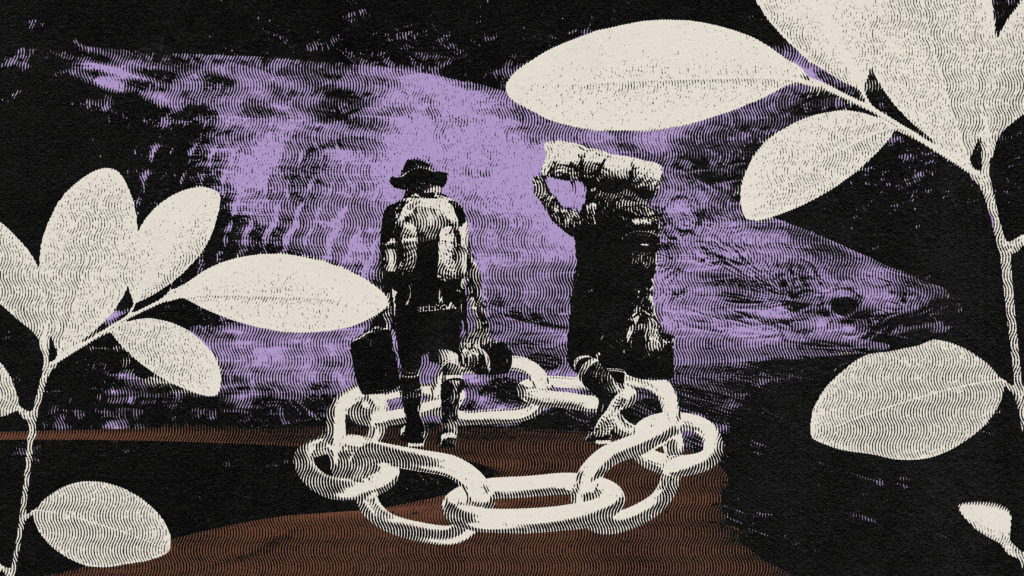
The problem is closely tied to the growth of coca leaf crops and processing laboratories in Peru, where Peruvian and Colombian traffickers and Brazilian criminal groups control plantations. Farflung Indigenous families along the Amazon River travel there to strip coca leaves, and in some cases are paid in coca paste, which they consume or resell in their communities.
The rise in use is also visible in the appearance of “ollas”, or open drug sale points, inside Indigenous communities.
“We’re trying to work together with the military to tackle this problem that has taken hold inside our community,” says Raymundo Fernández, a community leader and coordinator of the Indigenous guard in Azcaita, which brings together ten Indigenous communities in Amazonas.
He explains that young people either use drugs themselves or offer to push drugs for outsiders who come to supply them within the communities.
“Once they’re in, they can’t get out, because they’re threatened by the people who supply them,” Fernández says, adding that the situation has become so severe that the community now has young people living on the streets.
As of December 2025, Leticia’s streets had 224 homeless residents, 37 more than in 2024, according to data from local health authorities. A security official said that of that total, 35% are Indigenous, most of them young men, amid a small-scale drug trade controlled by Brazilian crime group Comando Vermelho (CV). This powerful group was born in Rio de Janeiro’s Cândido Mendes prison 50 years ago, and its presence has since spread across Brazil and neighbouring countries. The United States government designated it a terrorist organisation on 28 May.
FROM COLOMBIA TO PERU
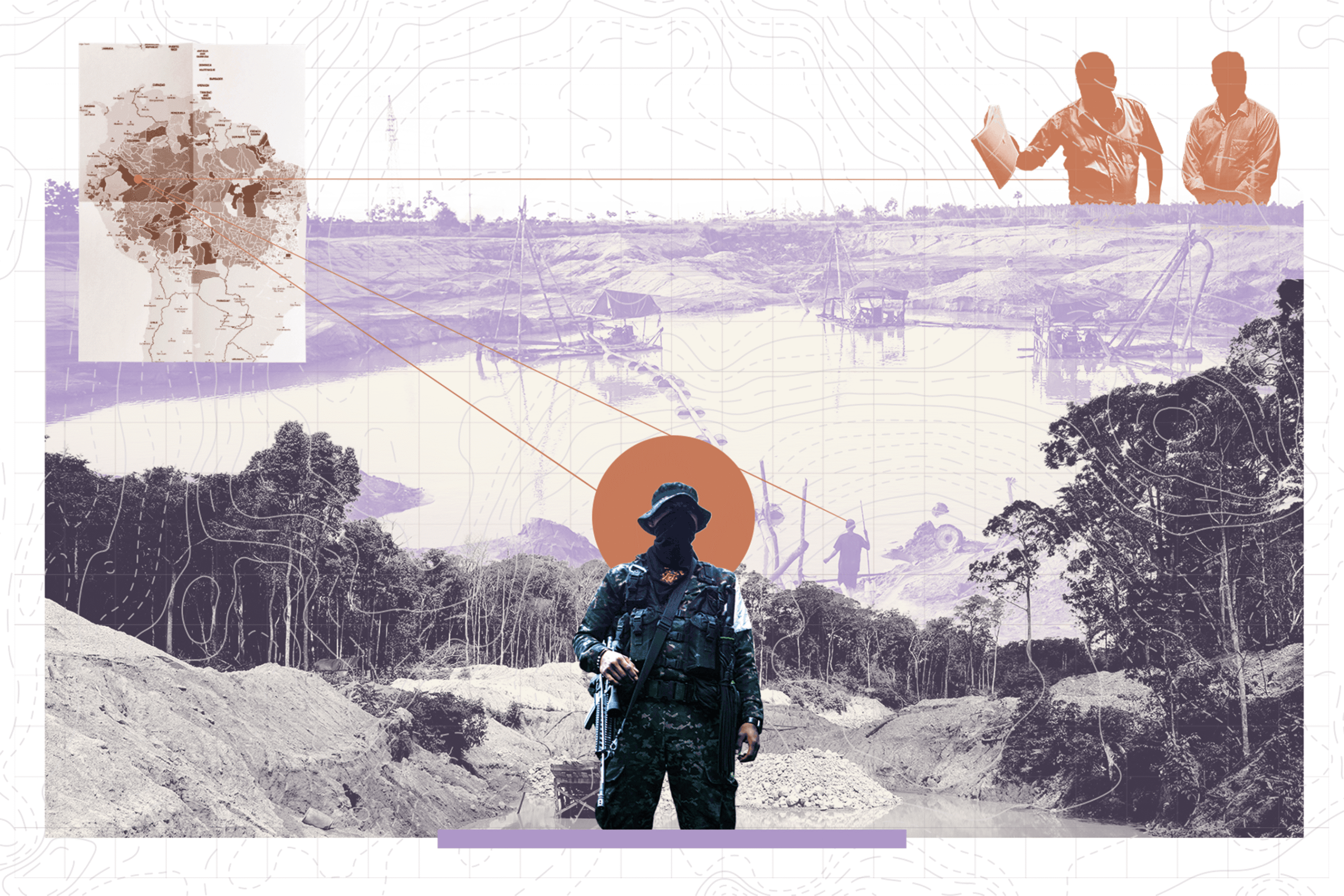
Among several Indigenous Amazonian communities in Colombia, one place in Peru is well known as an epicentre of coca cultivation and production: Bellavista. It is a Tikuna Indigenous settlement in the province of Mariscal Ramón Castilla, in the Loreto region, and according to the United Nations Office on Drugs and Crime (UNODC) most recent report, it is the third native community with the most hectares of coca leaf in the country, going from 307 hectares in 2020 to 786 in 2024.
“We have this CV hegemony, and the Brazilian command has its base in Bellavista,” the commander explains. “When I say ‘command’, I mean the more operational arm, the production and logistics side, because the financial side is a whole tangle of companies involved in money laundering.”
By Soares’ estimate, the business is highly lucrative for CV, which has managed to impose total control after negotiating with Peruvian traffickers and deciding who can buy in the region and who cannot.
A kilo of coca bought in Bellavista for US$300 sells on the streets of Europe for between 22,600 and 41,800 euros.
To launder the proceeds, CV finances illegal gold mining in rivers such as the Puré (shared by Brazil and Colombia) and, more recently, the Juruá (which rises in Peru and crosses the Brazilian Amazon), and also buys gold directly from miners. It launders money through the trade of pirarucú, the largest freshwater fish in the Amazon River, which is sold legally. “You take that illegal gold money, change it at the exchange house, turn it into Brazilian reais… and that’s it, it’s clean,” Soares explains.
The trips many Colombian Indigenous people make to strip coca leaf and “quimiquear“, as they colloquially call working in the laboratories, in Bellavista and Peruvian settlements such as Islandia or Santa Rosa, can be one way. “We don’t go, because we’re afraid: people who go to strip the leaf get paid, and then they get killed,” says Catachunga, the health promoter. “We see dead bodies in the river, and we know what it means.”
A young man from Nazareth, whose identity we are withholding for safety reasons, said there are young men who have gone to Peru to strip coca leaf.
“Some agree to go and do the stripping, others agree to go to the bigger thing, where they cook it,” he said. Another 26-year-old, who also asked not to be identified, said he had been offered the work but refused to go. “I have friends from other places who’ve gone, and they tell me not to,” he said. “You end up mixed up with criminals, and if you steal something, they’ll hunt you down until they find you, or you stay stuck in the olla.”
Whether or not they go, young people from this and other Indigenous communities become trapped in addiction, which some have tried to treat in Leticia.
CURE AND ILLNESS
Juan* was 13 when he started smoking marijuana. He was living in La Pedrera, an Indigenous Amazonian settlement on the banks of the Caquetá River, when men from the Estado Mayor Central, a dissident faction of the former FARC-EP guerrilla group, came to recruit him. His grandmother, who has raised him following his mother’s death, remembers that the dissidents were so pleased to have taken 15 children that they threw a party to celebrate. Members of this group often approach young people while they are playing football or out on the street, offering them food, drink, and money to draw them into transporting marijuana or coca paste.
But Juan refused to go, so he was given an order: disappear from his town within 24 hours. His grandmother brought him to Leticia to escape, and through the Indigenous health provider IPS Indígena Mallamas, he ended up at IPS Nuevo Amazonas, another health provider. Its legal representative and manager is Dr Henry Esteban Porras, a psychiatrist born in Leticia who studied in Bogotá before returning to practise basic psychiatry, and set up the IPS (“Institución Prestadora de Salud,” or Health Service Provider) in an abandoned house that had once been the brothel “Bunny Show”.
“It was a very ambitious brothel that failed (…),” says Porras, sitting in his office, where three diplomas from the Pontificia Universidad Javeriana hang on the otherwise bare wall.
He recalls that when the centre opened in 2017, it adopted the “therapeutic community model”, in which recovering patients guide others, with hierarchies between those further along in recovery and newer patients. In his words: it “uses shock-therapy strategies, very aversive and sometimes humiliating, used to get people to stop using, for example, putting signs on patients, or a lot of throwing water, buckets of water on them, or making them do press-ups, like soldiers.”
Jeffrey González, a psychiatrist specialising in addiction and public health, explains that therapeutic community treatment models emerged in the 1970s and aim to “rehabilitate behaviour more than the illness or disorder itself”.
“Science understood a long time ago that rehabilitating a person’s behaviour isn’t necessarily enough for someone with a substance use disorder, because behaviour isn’t the only factor,” Gonzalez said. “Biological, psychological and social factors also need to be taken into account, beyond conduct.”
According to Porras, the centre stopped using that model in 2018. It now has a team of three psychologists, a social worker and an occupational therapist, applying, in his words, a “biopsychosocial approach, based on relapse-prevention theories and therapies, family intervention, and social and community rehabilitation, with a human rights approach”. But Amazon Underworld collected seven testimonies from young people who have been through the centre since 2020, or from their relatives, and most describe mistreatment. Juan*, for instance, entered the centre in 2024 and says staff shouted at him.
“Not at you, but at the addict inside you, they shout that the addict inside you is the one who misbehaves and causes trouble and steals and all that,” Juan said.
He also recalls being locked up for a day at a time, “because you were causing trouble, because you shouted at the leader (…) they’d leave you without snacks, without calls, without visits.”
The mother of Pedro*, a young Tikuna man who was in the centre in 2022, says she visited her son a month after he arrived and he told her they were forced to sleep in their underwear on a mat in an isolated room, and that some of his fellow patients were sometimes beaten as “punishment”.
The father of Víctor*, who was in the centre three times, says his son was made to sleep naked and had “water thrown on him”.
“When I found out about this harsh reality, I stopped sending young people there,” the man said.
Ramiro*, another 26-year-old, says he ended up caught in his addiction after selling bullets to a Comando Vermelho member in exchange for coca paste. In 2022 he entered the centre to avoid being pursued. Although he says he was not mistreated himself, he described the case of a young man who smoked marijuana inside the centre. According to his account, the “punishment” was being locked in a room in his underwear with a mattress and made to write lines in a notebook reading “I must not smoke marijuana, I must not smoke marijuana in the centre.”
“That kind of punishment is normal in there,” Ramiro said. “Anyone who messes up, who fights, who steals, gets punished, anyone who touches other people’s things, who does something wrong, basically.”
“My boy came back and told me, mum, I left because I didn’t like it there, they mistreat you psychologically,” says another interviewee, whose identity we are withholding to protect her. She later sent another son, who also ended up escaping from the centre.
“I went through mistreatment when I tried to escape the first time,” says Octavio, who managed to escape the centre. His mother considered legal action. “They gave me three 100-milligram pills, 300 milligrams in total. I felt like I was in a coma, and that made me furious. I was paralysed, half my body wasn’t working, but my brain was still active, and I thought: I’ll recover, and I’ll jump that fence to get out of here.”
His mother asked: “Why did the boys leave? Why weren’t they returned to me healthy?”
Porras acknowledges that in recent years the centre has received complaints about treatment that patients considered unfair or aggressive, but says: “Overall, complaints of mistreatment, no. Very few. I recognise my share of responsibility, and the mistakes that may have occurred at my institution.”
“We used to have a ‘reflection room’, a room where if you were very aggressive, you’d stay there, but we ended that more or less before the pandemic,” Porras says.
He explains that the “reflection room” was a legacy of the therapeutic community model but says it was discontinued; today it is simply called room 5, an ordinary room. He also says the room was never “a method of punishment, it was about managing aggression, aggressiveness.”
Asked why many young people who go through the centre do not recover, Porras says: “Even when you intervene with a population that has severe addictive pathology, recovery rates rarely exceed 50 to 60%, and it depends heavily on the characteristics of the pathology.”
“Technically, in Amazonas we don’t have mass-care models for people with addictions,” Porras added, admitting that staff have sometimes been a source of danger, and that he has had to dismiss employees over it. “I had to fire a guard because after patients finished the programme, he would contact them and offer to get them into prostitution.”
Porras is also identified as a nephew of Evaristo Porras, the well-known drug trafficker and head of the Amazonas Cartel, who died in 2010. “I can tell you my community hasn’t mistreated me for being his nephew,” he says.
Porras says he met his uncle only once, at the age of five, because “he spent my whole childhood in prison (…) In Colombia.”
“Who doesn’t have a relative who’s had something to do with drug trafficking?” Porras asked. “I find that stigma very unfortunate.”
Other sources point out that he won a contract, running from October 2024 to 30 January 2025, worth 4,465 million pesos (nearly a million dollars), the largest this IPS has signed with the departmental government, for being a relative of Ramiro León, partner of Liberal congresswoman Karina Bocanegra, a powerful figure in the department who campaigned for him and is an ally of the current governor, Óscar Sánchez.
The contract aimed to strengthen mental health support networks, train communities and conduct screening in Leticia, Puerto Nariño and the department’s non-municipalised areas. It also sought to survey more than 10,000 people across age groups to inform a departmental mental health study. Porras says he won the contract as the sole bidder because his was the only mental health IPS in the area.
Although the departmental government transferred a 50% advance to the IPS (2,232 million pesos), it only spent 1,835 million, and had to return nearly 397 million pesos.
Sandra Viviana Arias, the official in charge of the departmental government’s mental health programme and supervisor of the contract, told Amazon Underworld that the IPS only spent that amount because “the contract was only carried out in all the Indigenous communities of Leticia and Puerto Nariño, but didn’t reach the whole department due to time constraints.”
Porras says: “Budget-wise, the operation ended up cheaper than projected. It covered the entire Amazon trapezium, which holds 70% of the department’s population, but didn’t cover the non-municipalised area, which is why it cost less.”
Another option for many young people in the triple frontier struggling with drug use is joining religious foundations, betting that faith in a higher power will help them recover.
GLORY TO GOD
“God bless you boys, say glory to God,” says pastor Arley Tavares, founder in Brazil of the Christian Foundation Rescued by His Blood, which presents itself as a non-profit organisation founded in 2010 in Fusagasugá, a municipality near Bogotá.
According to its website, the foundation offers “processes of formation and restoration for people living on the street, alongside professional work in pursuit of the wholeness of man.” Its approach is theo-therapy, a treatment practice for psychoactive substance use based on preaching the gospel of Christ.
Tavares, a Colombian who describes himself as a recovering addict after 27 years of drug use, walks through the foundation’s headquarters in a Tabatinga neighbourhood controlled by Comando Vermelho. The building was once a drug den. As he heads towards a courtyard, four men wearing foundation ID cards around their necks spot him and respond in unison: “God bless you.”
“These boys have just returned from collecting food,” Tavares says. “I really want to say that this is work done with love, with affection. It’s voluntary; no one here is forced to do it,” he says, looking at the camera.
“Here, they taught us the word of God, and thank God we heard about this foundation, because God is the one who changes you. And here we are,” one of the young men says.
Under the biblical phrase “nothing is impossible for God”, the foundation now has more than 40 branches, most of them in Colombia, alongside others in Ecuador, Brazil and Panama. It arrived in Leticia in 2016, in a house very close to IPS Nuevo Amazonas. According to Tavares, it treated up to 110 people there until 2019, when it closed its doors in Leticia to reopen in Tabatinga.
Two Leticia public officials, who asked not to be named, said the foundation closed while under scrutiny over allegations that it was bringing people from other parts of the country to join it, a claim Tavares denies. The Amazonas departmental health secretariat said the foundation is not registered, and therefore could not provide information on why it stopped operating in Leticia.
The foundation arrived in Tabatinga in 2019, amid a deadly war between criminal groups. On one side was Os Crías, backed by the Primeiro Comando da Capital (PCC), which emerged from a São Paulo prison; on the other was Comando Vermelho (CV). CV won the war in 2023 and now controls several Tabatinga neighbourhoods, including the one where the foundation is based. The letters “CV” are spray-painted on the walls of nearby houses.

In Brazil, Comando Vermelho is known to offer young members only one way out of the group: joining a church. “There’s no institutional link, no church is formally tied to CV. That doesn’t exist,” says Soares, commander of the Eighth Military Police Battalion in Tabatinga. “What exists are internal CV rules stating that if someone wants to leave crime behind, they can only do so by turning to a church. But going to church and actually living by it… if they later catch you using drugs, drinking alcohol or behaving in a way that doesn’t fit someone walking in the word of the Lord, they kill you.”
In Benjamin Constant, a Brazilian town 20 kilometres from Tabatinga, some evangelical church leaders are former CV members, as reported by El País América.
This informal relationship between churches and armed groups, unwritten but apparently respected, also plays out inside Tabatinga’s prison. According to Walmir Barbosa, coordinator of the Diocese of Alto Solimões’ prison ministry, “those who go to church, who really change, are left alone. It’s called the ‘cell of blessing’.”
Tavares founded Rescued by His Blood in this complex environment and says he has no problem with CV because the foundation is “well known”.
“What do they ask of us? If it ever comes up, it’s like the police. What does the Federal Police ask of me? That the boys don’t cause harm, that they behave well, that they set a good example (…) We don’t focus much on whether they control an area or not, because honestly, that’s not our business.”
Rescued by His Blood is known locally as the “peanut foundation” because its members sell peanuts on the streets and at Leticia’s port. Some residents see this as exposing them to drug dealers, but Tavares says the sales are simply how they support themselves.
“The foundation doesn’t only sell peanuts, and it’s not the only foundation that does. It might expose them, sure, but we have no other way. Who pays the rent on this house? If his family doesn’t pay a monthly amount, how do we keep the house running? How do we pay the rent?”

At Leticia’s port, young people wearing foundation ID cards can often be seen selling peanuts for 2,000 pesos ($0.50) a packet. One seller said he keeps 500 pesos from each sale, with the remaining 1,500 going to the foundation.
“We earn 500 pesos per bag of peanuts. It’s like a job, both for me and for the mission,” he said. The money given to the foundation, he added, is sent to other locations to help open and run new branches and pay their rent.
In the Indigenous communities of the Amazon’s triple frontier, thousands of kilometres from the European ports where a kilo of cocaine can sell for tens of thousands of dollars, the wealth generated by drug trafficking never arrives.
The addiction crisis is not only a consequence of drug trafficking but part of how the trade operates. Indigenous communities that have long been involved in growing, transporting or processing coca have also become a market for drugs moving along the Amazon River. As criminal groups consolidate their power, Indigenous young people bear the brunt, caught between recruitment, addiction and violence. The state response remains inadequate.
But even amid this landscape, some are trying to break the pattern. Health workers like Geni Catachunga keep visiting communities to identify young people at risk. Indigenous leaders organise community guards to stop drug dealers from entering. Families and communities try to prevent their children from crossing the river to the coca crops in Peru.
These are small efforts against criminal economies that move millions of dollars and span countries. Without a sustained state response, they will struggle to be enough against a public health problem still lacking answers grounded in prevention and harm reduction. But they show that in the Amazon, the dispute is not only over control of trafficking routes, it is also over the future of entire communities.
*Names have been changed to protect the identity of sources.