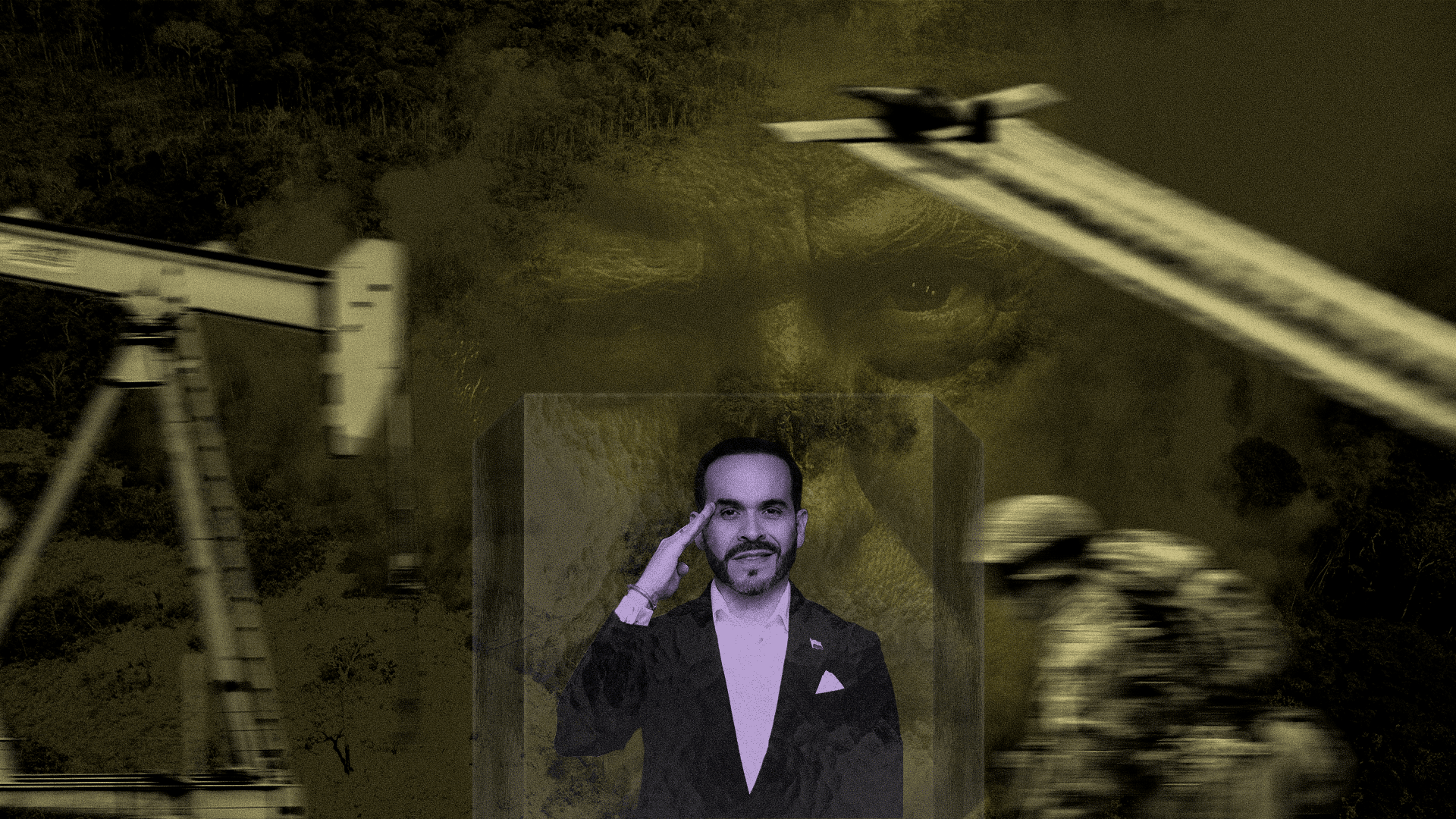
Right-wing governments are taking power in Colombia, Ecuador and Peru, aligned with trends toward militarization and hardline tactics. But war rhetoric and show-of-force actions accomplish little and put local populations' rights at risk.
Few places capture today’s security challenges in the Amazon as starkly as the triple border shared by Colombia, Ecuador and Peru. The geopolitical picture is distinctive: right-wing governments there favor militarization, extractivism and hardline security policies, and have drawn closer to the United States under the banner of the “war on narco-terrorism.”
In the region, extractive activities and illicit economies — gold, critical minerals, cocaine and oil, all highly profitable in global markets — converge with highly adaptive armed groups and weak, absent, corrupt or violent states. That combination is dangerous.
Abelardo De la Espriella, who takes office as Colombia’s president on Aug. 7, has given armed groups “90 days” to surrender and vowed to end any peace process in Colombia. Peruvian President Keiko Fujimori has promised to build mega-prisons and pull Peru out of the Inter-American Court of Human Rights to “restore order.” Ecuadorian President Daniel Noboa has already declared “total war.” All three leaders know little about the Amazon, yet all three have Washington’s backing. The U.S. has rebranded the problem as a fight against “foreign terrorist organizations” and launched the Shield of the Americas initiative to “regain control of its hemisphere” and its natural resources, according to its own national security strategy.
Militarization and criminalization do not solve a structural problem. States must enforce the law and take cross-border security seriously, but the real question is how. A recent report by Amazon Underworld and Amazon Watch on the triple border, published in July, warns against reviving old strategies that have already failed. It proposes a different approach to peace and security — one that puts communities at the center and dismantles the systems that enable crime.
War rhetoric and show-of-force operations do little to achieve that goal, and they endanger the lives and rights of local people, as recent months have shown. On March 3, Ecuadorian forces set fire to what they described as a “narco-terrorist” camp in Sucumbíos; three days later, they bombed the site with support from U.S. Southern Command. Later reporting found it was actually a cattle ranch — investigators found no weapons, and residents reported torture. In June, three Shuar community members died during an anti-mining operation, also in Sucumbíos; the community and the army have given conflicting accounts. Meanwhile, the Colombia-Ecuador Amazon border has stayed closed for months, hurting the Indigenous peoples and local communities who live on both sides of a line they never drew — while organized crime crosses it with little trouble.
The armed groups operating on the border are not invading armies. They are embedded in the local economy, in daily life, and in the region’s political and institutional fabric. Amazonian communities face threats, extortion, forced recruitment and confinement — but state repression and neglect harm them too, while illegal gold mining poisons their rivers and damages their health. Any strategy that ignores this reality cannot be called a security strategy. Soldiers and airstrikes will not fix the problem; building trust and working with local communities will.
The peace process with the Comandos de la Frontera (CDF) in Colombia proves another path exists, though it has clear limits. Homicides in Putumayo fell from 183 in 2024 to 41 in 2025, and nearly 13,000 families signed agreements to substitute illicit crops. In June, 99 CDF members entered a Temporary Location Zone, the most concrete step yet toward disarmament. But contradictions persist: the group denies operating outside Colombia even as it expands its reach into Ecuador and Peru; it stopped buying coca paste locally only to push cultivation across the border into Peru and pivot its business toward gold; and it still holds territorial and social control over communities. Colombia’s Human Rights Ombudsman’s Office has warned that the process is moving forward without adequate safeguards or independent oversight. Even so, scrapping it by decree, as President de la Espriella has promised to do, would not end the violence — it would escalate or displace it, stripping protection from communities and from those who have already demobilized.
Peru faces a particular risk in this landscape: it combines the region’s weakest border institutions with a legal framework that successive legislative measures have steadily narrowed, limiting the state’s ability to fight organized crime. As neighboring countries pursue increasingly repressive strategies, the Peruvian Amazon could become a refuge and expansion platform for the illicit economies that sustain the region’s armed groups.
What would a government that genuinely wanted security in the triple border actually do? The answer has five parts. First, follow the money behind illicit activity — the routes for mercury, fuel, machinery and money laundering. Second, sustain the process with the CDF under firm conditions, rather than treating it as dead. Third, recognize and fund Indigenous territorial monitoring networks and local economic alternatives, the Amazon’s first line of early warning and protection. Fourth, fight corruption and build a state presence that serves local people. Finally, strengthen the regional cooperation across the Amazon that has deepened in recent years, and make any foreign military cooperation conditional on respect for humanitarian law and independent oversight.
The Amazon triple border now faces a critical political choice. It can become, once again, the testing ground for a new “war on crime” that pushes illicit economies to adapt and relocate without solving the underlying problem, while local populations pay the price. Or it can build a security architecture based on regional cooperation, one that puts communities at the center of the strategy rather than in the crosshairs. The window to choose that second path is closing fast, and the signs are not encouraging.
*Raphael Hoetmer is the Western Amazon Program Director at Amazon Watch and Jeanneth Valdivieso is editorial coordinator at Amazon Underworld.
___
This article was originally published in El País on Aug. 7, 2026.