Ecuadorian military officials admit that border areas and Amazonian roads have been left technically and tactically vulnerable as troops are redeployed to internal security under President Daniel Noboa’s campaign against the “non-international armed conflict” he declared in January 2024. The legal basis of that declaration, made amid an unprecedented security crisis, has been challenged at home and abroad by critics who say it fails to meet established criteria. Meanwhile, Colombian armed groups and Ecuadorian criminal gangs continue to consolidate power, driven largely by illegal gold mining and drug trafficking. Despite government claims of progress, enforcement has largely consisted of sporadic operations rather than a coherent strategy, allowing illicit economies to keep expanding.
A member of Ecuador’s military intelligence services, whom we’ll call Colonel Eduardo*, participated a few months ago in a patrol in a border zone of Sucumbíos province, near Nariño, Colombia, in the western sector of the Amazon region. At once frustrated and clear-eyed, he admitted that “for both armies it’s difficult [to cover the border zones] due to lack of resources.”
Colonel Eduardo explained that Ecuador’s Armed Forces cannot maintain border control “because of the countless activities they’ve assigned to us: we’re in the prisons, we’re doing camex [control of weapons, ammunition and explosives], we’re dealing helping the National Risk Management Secretariat with oil spills, and we’re controlling the oil pipelines.”
“What we’re doing least is patrolling the border,” he admitted.
With violence spilling over, especially in Ecuador’s coastal region — where drugs exit, coming mainly from Colombia, toward international markets — the Amazon’s border lines don’t appear among President Daniel Noboa’s priorities. This despite dynamics in those zones showing the expansion of Colombian armed groups and Ecuadorian criminal gangs, involved in activities like illegal gold mining and drug trafficking.
Citing Colombia’s lack of cooperation on security matters and border abandonment, Noboa on January 21 announced the decision to impose a 30 % tariff on Colombian imports, which sparked consternation among neighbors and only escalated tensions between the neighbouring countries.
Ecuador’s Amazon faces a growing crime problem that has permeated state institutions and ceded space to criminal groups. Comandos de la Frontera (CDF), one of the dissident groups from the former FARC rebel group, is currently in peace talks with the Colombian government. It exercises strong social and territorial control in Colombia’s Putumayo department, where coca crops and processing labs for cocaine base paste abound. Their activities cross the border in alliance with Los Lobos—a gang classified by Ecuador’s government as an Organized Crime Group (GDO).
Other FARC dissident groups also operate in the border region, though are not as established, including the Carolina Ramírez Front and the Raúl Reyes Front (both rivals of the Comandos). According to accounts from various border sources, Los Choneros, another Ecuadorian gang rival to Los Lobos, have ventured into Colombia to buy cocaine or base paste, sometimes clashing with the CDF.
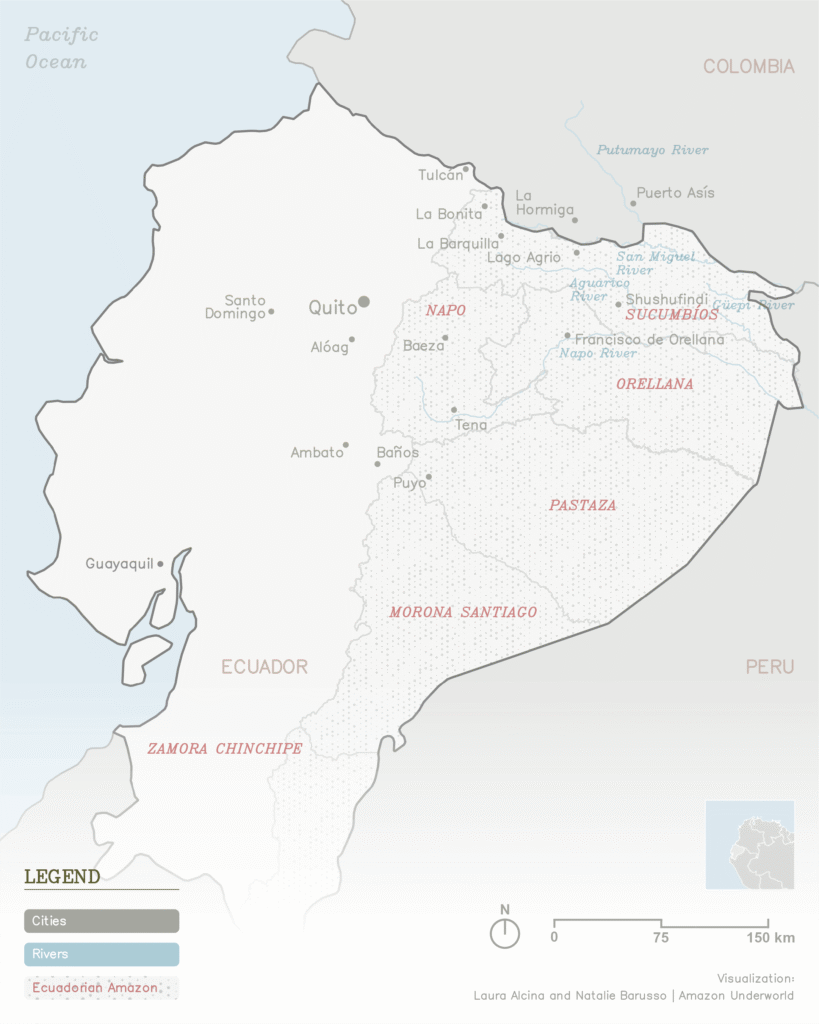
According to Colonel Eduardo, the main river routes used by criminal networks operating in Ecuador’s Amazon are the San Miguel and Putumayo rivers. These waterways trace the borders between the two countries and are direct passages from Ecuadorian territory toward Colombian towns including Puerto Asís and La Hormiga, which are under the control of the CDF. He also mentioned the Aguarico and Güepi rivers, for their connection with the Napo River, toward the southeast, with exit points to Peru.
Confidential military sources confirmed that through the end of 2025 there were more than 1,000 troops “with passes in the border provinces”—which extend from the Pacific Ocean, across the Andes and into the Amazon—but close to 70 % of that military personnel is assigned to internal security activities, formerly within the police’s remit. The Armed Forces’ incorporation into these tasks came after the government’s declaration of an internal armed conflict and implementation of a militarization security policy, the legality and effectiveness of which has been questioned by analysts.
For Juanita Goebertus, director of the Americas Division at Human Rights Watch, based in Washington, “it’s a mistake to characterize this as an armed conflict, not only because it doesn’t meet the criteria for level of organization and hostility, but because what deploying military forces has done is generate a perfect climate for abuses.”
“We’ve been very critical of the absence of a real security policy by Noboa’s government, because what we’ve seen is that deploying this strategy of declaring this as armed conflict has not only been ineffective, but has also generated very serious human rights violations,” Goebertus added.
ABUSES AND EXCESSES
The militarization of the territory intensified after the army took a hard blow from organized crime. On May 9, 2025, a battalion of 20 soldiers patrolling the upper Punino River area—at the intersection between Napo, Orellana and Sucumbíos provinces—was ambushed by armed men who murdered 11 uniformed personnel. The operation, according to the government, attempted to stop the advance of illegal gold mining in that sector. In the clash, Miller Rodríguez Ortega, alias ‘Compadre,’ was killed—identified as the Comandos de la Frontera leader in Ecuador who is responsible for controlling illegal mining operations and extortion of miners.
Contradictory versions circulated about the episode: government authorities attributed the attack to Comandos de Frontera, but Wálter Mendoza and Jairo Marín, the group’s leaders in Colombia, flatly denied their participation in the events.
Residents of the Punino area also ruled out Comandos de la Frontera as responsible for the bloodletting.
A local source, who requested anonymity for security reasons, attested that one member of that military patrol “belongs to this organization [Los Lobos] and they were the one who alerted him.
According to that source, due to the alert, the soldier avoided being party to the operation.
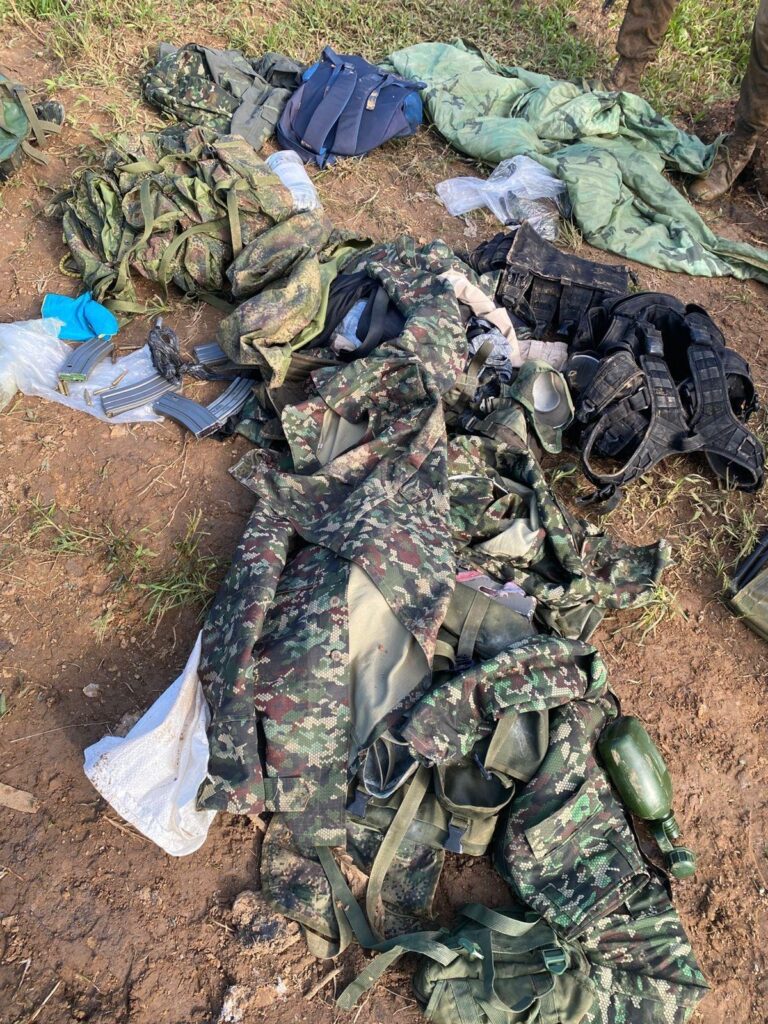
After the attack, Noboa’s government declared as organized armed groups the Colombian-origin groups Comandos de la Frontera, Frente Óliver Sinisterra (another ex-FARC dissident group) and Comuneros del Sur, a dissident faction of the National Liberation Army (ELN), which operates mainly in the Nariño department, also bordering Ecuador, and which is in peace negotiations with Colombian president Gustavo Petro’s government.
Additionally, Ecuador ordered the deployment of 1,500 soldiers, the largest military contingent in recent years, to the Amazon to “find and eliminate” those responsible for the ambush. There was discussion of establishing a tactical perimeter around the area, supported by offensive reconnaissance, territorial sweeps, and expanded aerial surveillance using helicopters and drones.
That military presence was felt in the Amazon region. An Indigenous woman from a community on the banks of the San Miguel River recounts that with the militarization all activity stopped, that at night they no longer heard boats. After the soldiers’ murder, the impact on the zone’s population was notable. Many feared for their lives, their communities and families, while other inhabitants of Napo and Orellana trusted this was the start of the eradication of illegal mining and armed groups. “But then time passed and we saw the boats were moving again,” the woman laments.
A few weeks after the ambush on the military, on a Tuesday afternoon in another border town in Ecuador, another group of about 20 soldiers burst into a family’s home.
They pointed weapons at those inside: a 10-year-old girl, a 17-year-old teenager, four adults—two men and two women—and even a dog. They said they were looking for weapons or drugs. “We have to squeeze this guy to make him talk because this guy must know something,” said one of them, pointing his gun at one of the men, according to the account in a complaint filed with the Prosecutor’s Office. They rummaged through drawers and cupboards and snatched the cell phones from the two minors. When they left and the family tried calm the shaken youths, they discovered the soldiers had stolen a piece of jewelry valued at $400 and about $240 in cash.
“They entered very humble homes of people who live from fishing, who sell a little fish to buy salt or oil, and in their absence they’ve entered the house and taken the woman’s clothes, 30 dollars (…)
They’ve even taken machetes. What does a machete have to do with irregular armed groups if that’s people’s work tool?
Why do they take things?” asked a community member living in the town of Cascales.
For residents, the Army’s presence transformed from a promise of safety into a source of anxiety, as communities began to fear—not welcome—its arrival.
“They saw a motorcycle parked outside a house while the owner was away and took it. They started treating everyone as if they were linked to armed groups. They detained two young people on a motorcycle, tortured them, left one in the forest, and abandoned the other barely conscious after severe beatings—supposedly to extract information,” said a protected source in a border Indigenous community.
In September 2025, Amnesty International released “It was the Military, I Saw Them“, a report examining five cases of forced disappearance in Ecuador in 2024 linked to the government’s declaration of an “internal armed conflict”. Since then, cases involving alleged extrajudicial executions, forced disappearances, arbitrary detentions, and torture have reached the courts. The Ecuadorian Amazon, however, remains absent from official statistics.
In operations following the attack on the military, mining camps and homes were destroyed and heavy machinery was seized. In September 2025, Noboa’s government announced the “new phase of the war” which included nine provinces—among them Sucumbíos, Orellana and Napo—to neutralize high-value targets and reinforce controls. Drug seizures were reported and two people allegedly kidnapped by the Comandos de la Frontera were rescued.
Four months later, on February 2, the Ecuadorian government announced the indefinite suspension of all mining activities in Napo, where one of the illegal gold mining hotspots is located.
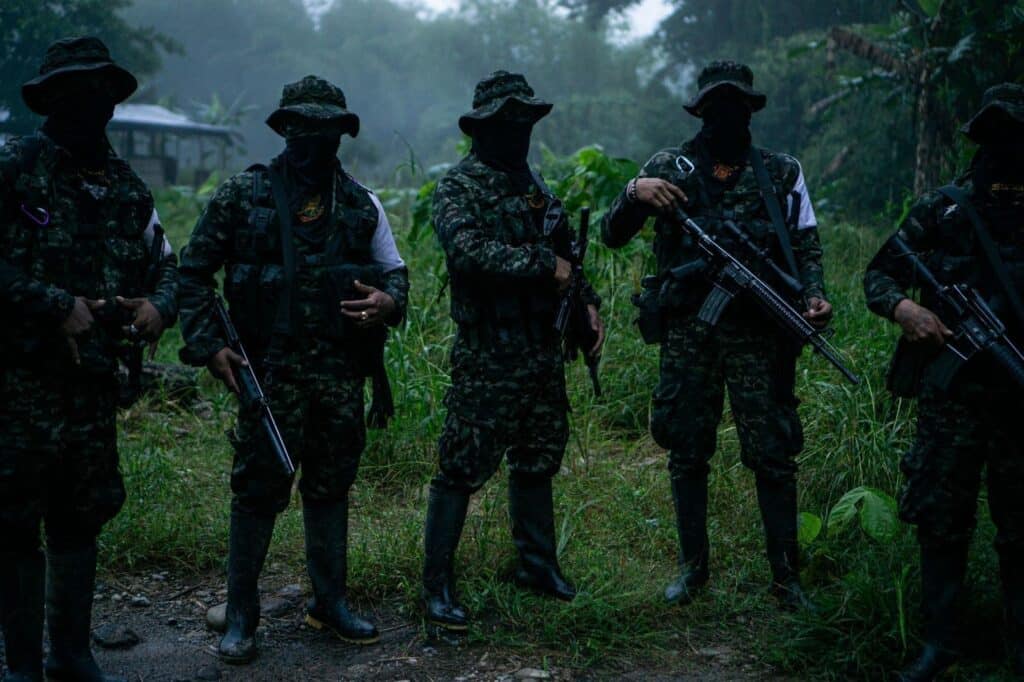
Katherine Herrera, an international political scientist with a master’s in National Security and Defense Research, criticized the reliance on isolated operations over a permanent, sustained presence. “The Armed Forces’ actions remain largely tactical and reactive, focused on immediate, situational responses, without any sustainable long-term development,” she said.
“There’s no public policy, there’s no strategy,” she noted. “The Amazon should have its own strategy to face these threats and risks due to its territorial and geographic composition and its population of Indigenous peoples and nationalities.”
And she added that the Armed Forces are already experiencing “wear and tear” from their involvement in internal security tasks.
A second protected source within military intelligence—identified here as Colonel Bernardo*—pointed to a lack of equipment to confront growing threats in the region. “It’s not enough to send personnel to the border; you need technology, helicopters, fighter aircraft, ships. To carry out all missions, you must be properly equipped for war. That’s why they attack us in Alto Punino—why they bomb and ambush us—because we’ve been diverted from our core mission.”
Colonel Bernardo also warned that exhaustion is beginning to erode discipline.
“People are starting to get corrupted, to give up. There are growing discipline problems—some are looking for ways to leave or secure discharge. And it’s not the youngest; it’s those who’ve been around the longest,” he said.
To address Armed Forces operations in the Amazon, we requested public information and an interview with the commander of the IV Amazonas Army Division, General Fernando Silva, but received no response.
A MAP OF SILENCE
“That guy is one of those people,” the woman whispered, barely moving her lips, head down, her gaze fixed on the beach sand.
The man in the canoe, standing beside the motor, glanced at us for a few seconds. He lifted a hand in a half-formed greeting, then turned back to the river and continued downstream. His figure shrank to a blur, the engine’s hum dissolving into the jungle. Only then did the woman look up, and we walked on.
“By the way they act, we can tell who they are… they’re strange people. You just know they’re linked to that,” she says—that. In the Amazon, residents have developed a coded language to refer to armed groups and drug traffickers, relying on euphemisms like “those things,” “people into that,” “guerrillas,” “the FARC,” or “the mafia.” Whether they belong to Colombian armed groups, Ecuadorian criminal networks, or local gangs often makes little difference. Some call them Los Lobos; others link them to Los Choneros, the labels used loosely, almost interchangeably.
Uncertainty over who controls armed activity in Ecuador’s Amazon is widespread, driven in part by the rapid and shifting criminal dynamics in the region.
“Most of them are Colombians. They have people stationed along the border who report any Army movement—and there are Ecuadorians helping them,” the same woman said. Then, more quietly: “You won’t say you spoke to me, right? Don’t use my name. Don’t say I told you this—here, everyone knows who everyone is.”
Land routes also function as criminal corridors, used by armed groups, illegal mining operators, drug traffickers, and fuel smugglers. Key examples include the road linking Carchi province in the Andean border region to Sucumbíos, home to the San Miguel Binational Border Center (Cebaf), just a few kilometers from the frontier, and the highway connecting Francisco de Orellana and Tena, which ties together two major Amazonian capitals.
“Sometimes we see them arrive. They’re there in the forest as if nothing’s happening, in boats loaded with sacks that look like sugarcane, so they don’t dar papaya,” an elderly man explained, using an expression akin to ‘asking for it’.
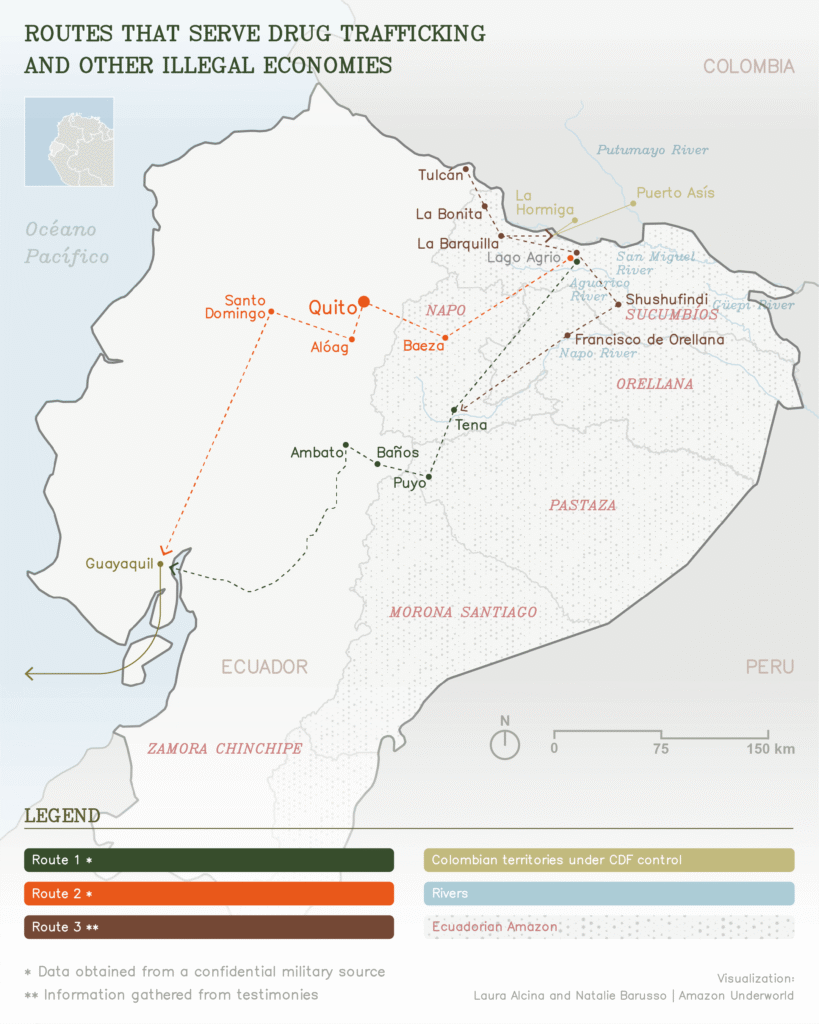
Colonel Eduardo mentioned two main routes for drug trafficking, contraband, and illegal logistics, running from the northern Amazon through the Sierra to the Coast, ending at the port of Guayaquil, the country’s main export hub for cocaine-contaminated containers.Testimonies from the past two years point to a third route, from Tulcán to La Barquilla—at the Amazon’s entrance—then through Cascales, linking the northern Amazon’s main cities with national road networks toward the inter-Andean region and the Coast. Armed groups, especially the Comandos de la Frontera, are the primary users.
While in Colombia the Comandos de la Frontera have agreed with the Colombian government to destroy weapons and substitute coca crops within the framework of peace talks, there is evidence that they continues wreaking violence and harming populations on both sides of the border. In Putumayo, they are accused of murders and threats against local leaders, of recruiting minors, of controlling who enters and who leaves,and of imposing punishments and confinements. On the other side of the border, they are involved in drug trafficking and illegal mining.
Human Rights Watch argues that the way dialogues have been conducted under President Gustavo Petro’s so-called “total peace” policy has enabled armed groups operating along the border to grow stronger. The process has allowed these groups to expand territorial control and commit abuses against local communities, said Juanita Goebertus.
According to expert Herrera, ties between Colombia’s irregular armed groups and Ecuador’s criminal gangs are not partnerships between equals. She argues that the relationship between Los Lobos and the Comandos de la Frontera in Ecuador’s Amazon is better understood as a “functional alliance,” in which transnational criminal networks hire local gangs to provide services such as route intelligence, access to storage sites, kidnappings, extortion, retail drug sales, and human trafficking.
Herrera pointed to the lack of state actions against what she defines as a “major actor of transnational organized crime, which affects different countries where it has presence, weapons capacity, training and cash flow, and is embedded in the political system allowing it to make policy. They are the ones who decide,” she explained.
According to the specialist, assigning the Armed Forces tasks outside their mandate risks turning the sporadic presence of foreign organized crime into a permanent fixture in the Amazon.
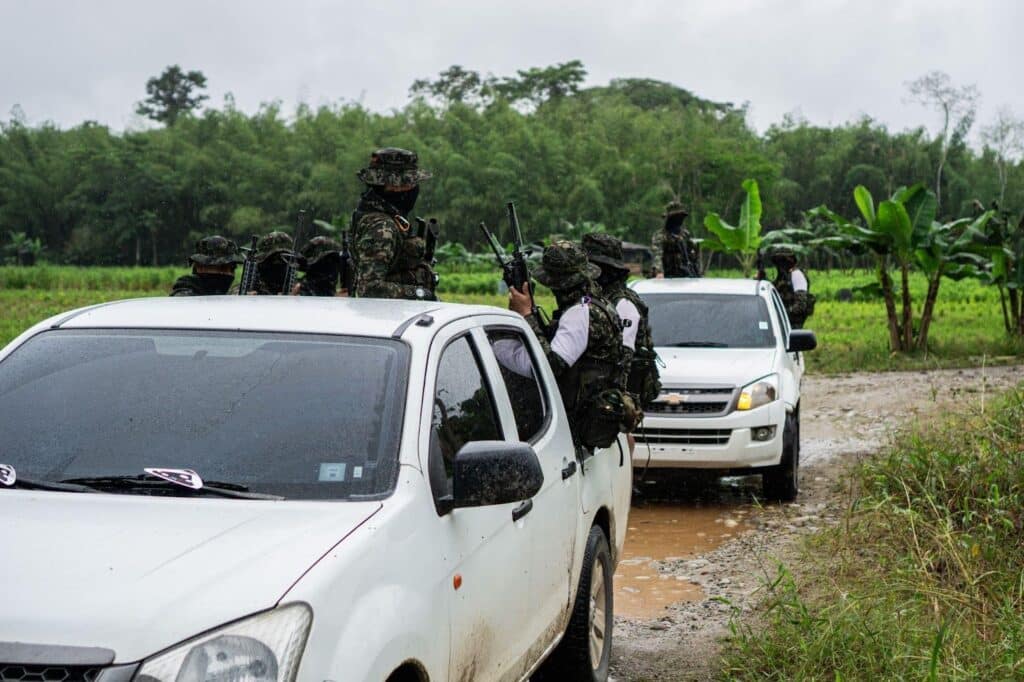
In Ecuador, the Comandos de la Frontera already operates with local leaders, according to authorities. One of them was identified as Roberto Carlos Álvarez Vera, alias ‘Gerente,’ a 45-year-old Ecuadorian, captured and extradited from the United Arab Emirates on December 30. Álvarez is accused of being responsible for the ambush in which the eleven soldiers were killed and of leading structures dedicated to drug trafficking, contract killing and terrorism. Others accused of being Comandos de la Frontera members have also been detained and the Prosecutor’s Office maintains an open case known by the group’s name that involves alias ‘Gerente,’ his two children, and his wife for money laundering. All have been detained.
GROUP FRAGMENTATION
On June 4 last year—one month after the ambush that killed eleven soldiers—another military patrol encountered armed individuals while operating in the area between La Barquilla and the Puerto Libre sector, near the Colombian border.
According to the military report, the armed group had some 200 men, so the armed forces withdrew.
“Dialogue was entered into since being at a disadvantage in both personnel and weapons, a confrontation and possible casualties of all military personnel were avoided” (sic), the report noted.
“Dialogue was entered into since being at a disadvantage in both personnel and weapons, a confrontation and possible casualties of all military personnel were avoided” (sic), the report noted.
An official bulletin announced the following day that during the operation they detained one person, “who claimed to be part of the Carolina Ramírez Front, and was handed over to authorities for corresponding legal procedures.” Thus the Ecuadorian government took for granted that the Carolina Ramírez Front was also disputing territories and routes in this zone.
Colonel Alexander da Silveira, commander of the Cabal Group, in Ipiales, Colombia, told Amazon Underworld that there are 32 informal crossings along the entire border with Ecuador under his jurisdiction, which comprises part of the Andean zone and a northwestern Amazonian area, and two formal crossings: Rumichaca and Tufiño. “There were 35, but with the Ecuadorian Army three informal crossings were destroyed,” the Colombian military officer added.
Da Silveira referred to the encounter between 37 Ecuadorian soldiers and a large armed group that the Army initially identified as members of the Carolina Ramírez Front—about 200 fighters, according to official accounts. “We now have full confirmation that the group posing as Carolina Ramírez was not Carolina Ramírez, but the Autodefensas Unidas de Nariño (AUN),” he said. This version contradicts statements from Ecuadorian authorities and local sources.
The colonel said that, according to Colombian intelligence information, the so-called AUN are an arm of Comuneros del Sur, who are negotiating peace. “These AUN are doing what Comuneros cannot do directly, head-on, so as not to hinder negotiations with Gustavo Petro,” he explained.
The officer reported that the AUN, who operated in northern Nariño, have settled in a border zone between Nariño and Putumayo departments: “They themselves tell the civilian population: ‘we are AUN and we’ve come to clean the zone,'” he added.
Da Silveira’s map of irregular armed actors places Comandos de la Frontera operating “toward the Amazon, toward Putumayo and toward Sucumbíos.” He says the group exerts “indirect influence” in the area and warns of “a relatively stable and strong presence” stretching from La Pintada, in Ecuador, to Jardines de Sucumbíos, in Colombia, as well as in the Ecuadorian towns of Santa Bárbara and La Bonita—an assessment that aligns with local testimonies.
“All base paste is produced in Putumayo, where the climate allows coca cultivation,” Da Silveira said. “They move it to the La Victoria sector, across from Santa Bárbara and El Carmelo, where this year [2025] we’ve destroyed about 14 or 15 laboratories. Once it’s processed into cocaine hydrochloride, it’s routed through Ecuador, because sending it out through Colombia’s northern Pacific is much longer. Those labs make it easier for them to move the drug out through Ecuador.”
“We have a limitation and it’s that in that Putumayo sector, of Jardines de Sucumbíos, we don’t have operational reach. We can’t develop operations there because a mountain range divides us that limits our supply, logistical support and communications. That’s why our practical operational line reaches only to La Bonita,” the officer explained.
Days after the conversation with Da Silveira, Ángel Polibio Quendi, alias ‘El Indio,’ was captured in a pool hall in the Ecuadorian town of Maldonado, in Carchi province—a veteran leader of the Iván Ríos Front, a FARC dissident group belonging to Segunda Marquetalia, for alleged involvement with illegal mining in Ecuador and Colombia, possession and carrying of weapons and ammunition, and extortion.
On the Ecuadorian side, Colonel Milton Santillán, commander of motorized infantry battalion No. 39 Mayor Galo Molina, stationed in Tulcán, reiterated that between that city and the town of Julio Andrade there is drug trafficking, extortion and contraband smuggling. Now in the La Barquilla sector, in Sucumbíos, “more than contraband, its presence and permanent transit of guerrilla groups,” confirmed the Ecuadorian officer.
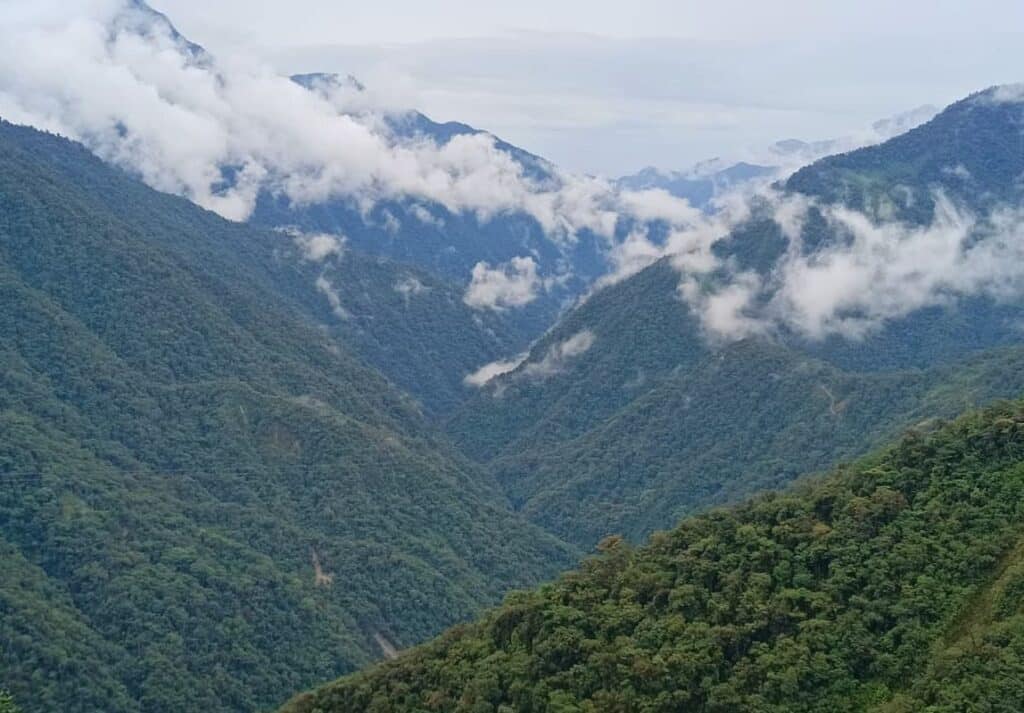
The connection between the Andean province of Carchi and the Amazonian province of Sucumbíos depends on the E10 Border Transversal. From Tulcán to Sucumbíos, the extensive highway navigates abysses, landslides and cliffs. Along the entire route there is only one military detachment.
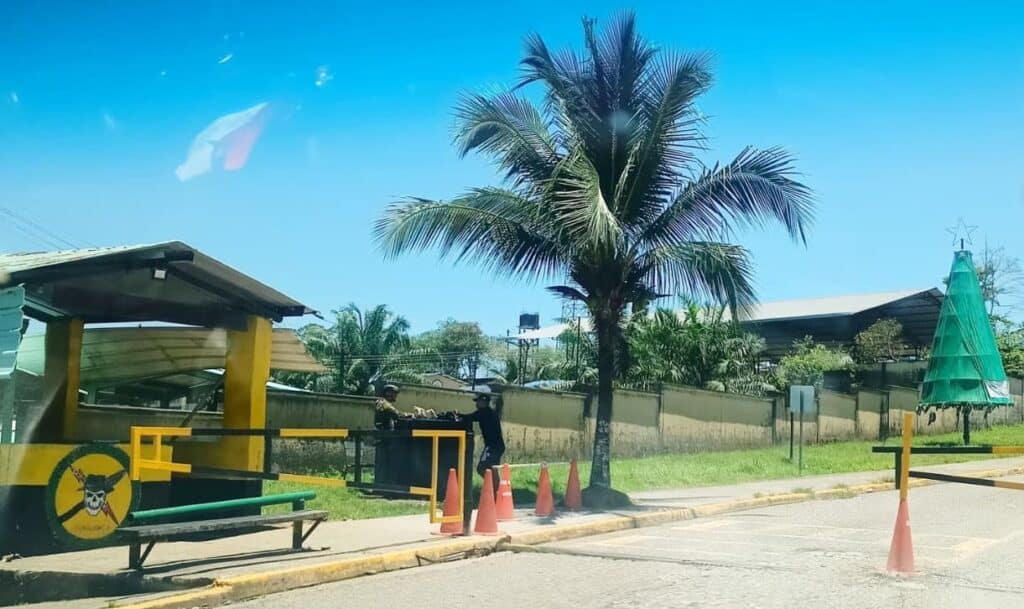
Seven or eight soldiers wandered around the checkpoint during a trip by the Amazon Underworld team. One of them approached—the barrel of his rifle hanging on his back stuck out above his head, the camouflage uniform seemed one or two sizes too large—he looked and asked where we were going and with the answer obtained, he let out a friendly “thanks, go ahead,” and moved aside. He was a young man,perhaps in his twenties.
It’s far from the checkpoints that illegal dynamics move on the Ecuador-Colombia border, a problem that worsens and for which there’s still no coordinated comprehensive policy as diplomatic and commercial tensions between the two countries escalate.
*Names were changed to protect sources.
.