Four unmarked white pickup trucks race through a patchwork landscape of bright-green plantations, blasting through mud puddles on winding jungle roads. As the convoy rounds a sharp corner, it draws worried stares from an entire family gathered at a wooden house decorated with birthday streamers—the festive mood suddenly shattered. Motorcycles quickly pull over, and children along the roadside watch with wide, fearful eyes.

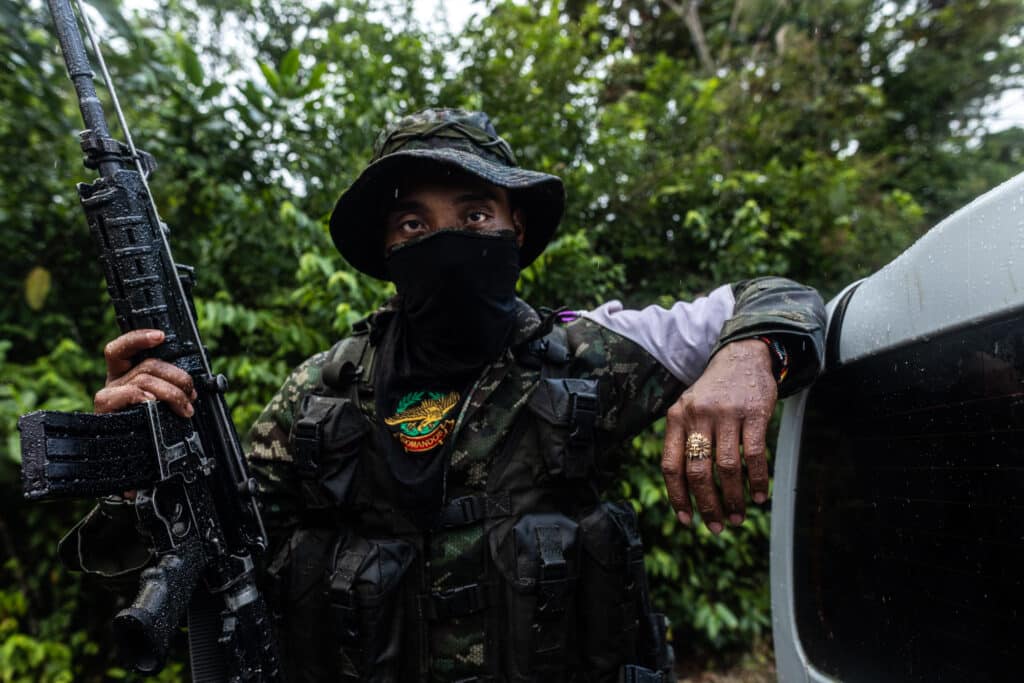
More than two dozen heavily armed men in military fatigues sit on the backs of pickup trucks, wearing wide-rimmed hats, black scarves and rubber boots. They belong to one of the mobile units of the Comandos de la Frontera, a Colombian armed group dominating an extensive network of routes connecting tens of thousands of hectares of coca plantations with the villages that supply manual labour. They link to trafficking corridors crossing several countries, leading to ports on both South America’s Pacific and Atlantic coasts.
Colombia is drowning in coca. The country now cultivates more than a quarter million hectares of the illicit crop—a record high that recently pushed the White House to consider decertifying Colombia as a partner in the war on drugs, which would end the flow of hundreds of millions of dollars in military aid and cooperation every year.
After decades of failed drug wars and forced eradication campaigns, coca production continues unabated. The keys to Colombia’s coca heartlands now belong to a new generation of armed groups that operate less like the country’s historic guerrilla movements and more like transnational criminal enterprises. They’ve adapted, evolved, and—most troublingly—they’re winning.
Colombian President Gustavo Petro’s “total peace” strategy promised dialogue and demobilisation, but three years into his administration, the armed groups hold the upper hand. With his presidency winding down and unable to seek a second term, Petro faces a stark reality. At best, he may secure partial agreements that barely put a dent in coca production; though even small victories could help ameliorate a troubling trend.
THE COMANDOS DE LA FRONTERA

One of the groups overseeing cocaine production is the Comandos de la Frontera. Colombian borderlands with Peru and Ecuador are among the world’s main coca-growing heartlands and while certain districts are violently contested by different armed factions, the Comandos remain the dominant group with swathes of territory under their hegemonic control.
In their fiefdom, the Comandos’ rule is totalitarian. They restrict access by having local community councils issue ID-cards to control who can enter and leave. The organisation also metes out crude justice, punishing thieves, for example, who steal from coca farmers. People who fail to explain their presence are occasionally tied to a tree while they investigate, facing torture and forced disappearance when there are no answers.
The Comandos public leader, Jairo Marín—who is also known by the alias ‘Popeye’—described the system of rudimentary justice in an exclusive interview in an undisclosed location on the border with Ecuador. “When we capture a thief, we first analyze where he’s from, how many crimes he’s committed, and then we might order him out of the area, we sanction him and the last line of action is to execute him,” he said.
Just like other members of the Comandos’ leadership, Marín belonged to the structures of the Revolutionary Armed Forces of Colombia—the FARC—of which about 13,000 fighters demobilised after a comprehensive 2016 peace treaty that ended over half a century of conflict with the guerrilla group. Marín, contemplative but concise, joined the now-demobilised FARC at 13 and is now in his fifties. Alias Chacal, a gregarious and pontificating local commander of a similar age who sat in on the interview, was only 11 when he enlisted.
Key components of the 2016 accord lacked funding at the end of the presidency of Juan Manuel Santos, who won a Nobel Peace Prize for the treaty. Under his successor Iván Duque, who lacked the political will to implement core aspects of the deal, the situation worsened. The state failed to protect former combatants, of whom more than 500 have since been assassinated.
Raised in conflict, peacetime offered little beyond exclusion, violent threats and death for the likes of Marín. Former combatants found themselves hunted by enemies old and new, but this time without weapons to defend themselves.
“We’re going to unite and we’re going to begin, we’ll arm ourselves because we won’t let ourselves be killed. That’s how we started this organization,” explains Marín. In 2017, 16 men gathered in southern Putumayo, near the San Miguel River that borders Ecuador, to found what would become known as the Comandos de la Frontera—literally “the border commandos”. Today, the organization boasts more than 1,200 armed combatants, including former soldiers and paramilitaries.
Putumayo is one of the most biodiverse regions in the world, where the foothills of the Andes morph into tropical rainforest. Prospected over generations by rubber barons, oil drillers, miners and drug traffickers, the region remains one of the Amazon’s most violent areas, with yearly homicide rates above 50 per 100,000 inhabitants.
Since the pandemic hit, the Comandos have expanded their operations into Peru and Ecuador, according to intelligence officials and dozens of interviews with sources in the region—though the group denies this cross-border presence.
On May 9, 11 Ecuadorian soldiers on an operation to target illegal gold miners were killed in an ambush attributed to the Comandos, which they also reject responsibility for.
While the Comandos deny direct involvement in drug trafficking, claiming they only “tax” the cocaine trade and illegal gold mining, community leaders, state officials, and intelligence sources dispute this. In coca-growing areas, the Comandos have killed buyers and sellers of cocaine and coca base paste who operated outside their control. This includes members of the Ecuadorian gang Los Choneros, who occasionally cross the border into Putumayo, a southern Colombian department, and rival armed group Carolina Ramírez, belonging to a FARC dissident structure called Estado Mayor Central (EMC).
Marín describes his organisation as a “21st century guerrilla”. While this partly reflects their modern fighting strategies—including military-grade drones with a 5-kilometer range for reconnaissance and delivering ordinance —as well as their absence of state-toppling goals, the designation primarily refers to their internal organizational setup.
The Marxist-Leninist FARC offered few liberties to combatants, who were detached from their families and received no income. In the Comandos de Frontera, new recruits earn a monthly “bonus” of $500, get holidays, and families of killed combatants receive an allowance.
Local members were seen making video calls to their girlfriends, scrolling through TikTok, and thinking about what to do with their monthly pay—behaviour unthinkable for those who fought with the FARC in a different era.
“You have to understand that we give the bonus because our fighters have their parents, their children, their wives, and that bonus or family bonus corresponds to them,” explains Chacal, sporting desert boots and military fatigues.
ROOTED IN THE REGION


Unlike other Colombian armed groups that typically send fresh recruits to faraway regions to separate them from their families and support networks, the Comandos keep their members within the territories like Putumayo where they were raised. “We’re regionalists”, adds Chacal. As a result, many communities feel a certain sense of proximity, as many families have a relative within the organization.
The Comandos understand the importance of controlling communities—embedding within them and having residents share information about army operations or rival groups. Over a heavy plate of grilled beef, Chacal stated, “if the army comes down this road, one of the local villagers will tell our guys immediately, we have a good relationship with the people.” While their supposed goodwill serves multiple purposes, this cooperation makes community members targets for both the Comandos and their rivals. The group prohibits theft, drug consumption, and disorderly behaviour, and fines and punishments are dished out accordingly. The Comandos say the money goes to community funds.
The Comandos draw manual labor from local communities, forcing entire villages to construct dirt roads by hauling sand and stones from nearby rivers to cover muddy tracks and fill gaps between small tree trunks laid horizontally across steep hillsides. In the eyes of law enforcement sources, these are highways for drug trafficking, but the Comandos see them as community development that benefits locals.
“The relationship between the communities and us is a fundamental part of who we are. [We become] supplementary to the communities,” Chacal explains. He argues the Comandos protect communities and work on ‘regional transformations’ in terms of rural infrastructure and political representation, advocating for regional development investments in current peace dialogues with the government. In doing so, instrumentalised local populations become a powerful tool for their socio-political agenda.
The community rhetoric appears to be more than mere legitimisation. Both commanders are natives of southern Colombian regions who, aside from their combat uniforms, could blend seamlessly into the local campesino population—their modest clothing and rural mannerisms would allow them to go unnoticed if not for their battle scars and the large rings adorning their fingers.
Neither Marín nor Chacal seem to fear the civilian population in their areas of influence—the hamlets they control most tightly. These are remote jungle settlements, accessible only by passing through checkpoints, where every other farm has a cockfighting arena and Mexican narcocorridos blare from every corner.
Members live and spend their time eating at local establishments, throwing around generous tips. Travelling with armed bodyguards recruited from the villages themselves, they move freely throughout the communities at all hours. In the evenings, they can be found hanging out in village squares, ordering barbecued meat for dinner like any other local.


“For example, we always act in the name of the communities, with mutual respect for the communities, and absolute respect for the Indigenous and Afro-Colombian communities. First of all, they have a different social organizational system. Only we, the Comandos de Frontera, are merely an incentive to improve [development] and security in the territories,” Chacal explains.
The key to their progress lies in their control over communities, which is often unwanted and achieved through coercion and the continuous threat of violence, or through a perverse sense of increased security.
In dozens of interviews on separate field visits with Indigenous leaders and campesino representatives—rural peasants—everyone requested anonymity, as repercussions for speaking against the Comandos can be lethal. Community members in Putumayo describe an asphyxiating form of control.
“They want to show the State that they are indeed working with the communities, but yes, with a gun,” said one Indigenous community leader. Ethnic groups have constitutionally recognised autonomous lands, with a certain degree of self-governance, but “they don’t give a damn”, another Indigenous leader said about the Comandos. The leader went on to blame them for recruiting members of their ethnic group, including minors, prohibiting Indigenous territorial monitoring squads from entering their own territories, and trying to buy off their leadership. “Cocaine money is making a difference in Colombia, but for the worse,” a campesino leader added.
In a region where the population depends on a cocaine economy controlled by armed groups, and where state agencies have failed to develop comprehensive programs for state-building, health access and public education, the Comandos are king.
NUEVO PAYA

¡Vamos México! The accordion strikes up its refrain, blaring through the speakers and echoing over the Putumayo River. It’s Sunday morning, a quarter to ten, and scores of men with glassy eyes after boozing all night sit in the taverns with tables in front of them full of empty beer bottles—just like the floor—as this is their day off. Not far away, heavy chanting emerges from an evangelical community center.
We are in Nuevo Paya, a settlement within La Paya National Park, inhabited by some of the Indigenous peoples living in the area, but mainly a village of ‘colonos’—settlers, some new, some who have lived there for decades. Many arrived after fleeing episodes of violent conflict, hiding in the jungle and often finding a livelihood in coca, the only viable economy in the depths of the jungle.
“We were displaced by the army, who shot bazookas, bombs and mortars at us,” says Jaime Ruiz, a coca-farmer known as ‘El Paisa’, who was displaced in 2013 as the army launched a series of attacks on the locally present FARC guerrilla. “They fired mortars in our direction, they landed near our houses, so, unfortunately, they also drove us out of our territories,” he says, explaining why he moved deep into the protected national park area.
The FARC demobilized after a 2016 peace deal with the government, but it took no more than two years for splinter groups and new armed outfits to show up in Puerto Leguízamo, a municipality in the department of Putumayo, bigger than Jamaica, bordering both Peru and Ecuador. The 422,000-hectare La Paya National Park covers almost half of its expanse.
To reach El Paisa’s farm, a small motorboat manoeuvres over a maze of streams and lagoons in dense rainforest, some of the creeks overgrown with jungle. Caimans and freshwater dolphins hide in the dark waters, while kingfishers and the prehistoric hoatzin—the living fossil—keep close to the water, and squirrel monkeys jump from branch to branch. Sandra Ahuite Otaya, a local community representative, jokes that while soldiers can hike into the park area during the dry season, the Navy boats cannot handle the shallow and small creeks full of tree trunks. She laughs that they, the illegal settlers, once had to guide out a Navy boat called a piranha.
Along one of the creeks, open spaces appear in the dense jungle. Some have wooden cabins on stilts, with many gasoline drums along the riverbank. The entrances to coca farms and their adjacent coca paste laboratories—to produce the precursor to cocaine—appear. In Paya National Park, there are at least 1,800 hectares of coca crops, the main ingredient of an illicit economy driving decades of conflict.
On one of those farms lives El Paisa. Wearing black cargo pants and boots, bare-chested, he walks around, chatty and energetic, while looking for his threadbare AC Milan football shirt and hat.
“We’re tired of this. We see that coca has always harmed this country”, he said as he walked through his 6 hectares of coca crops, which are good for four harvests a year. Despite the violence, the cocaine business enables El Paisa to pay for his workers and expenses and keep his business afloat. “Coca is a way to support ourselves, our children, our family”, he adds.
In order to phase out coca crops and replace illicit cultivation with legal food crops, El Paisa explains, a negotiated solution between the state, communities, and the Comandos de la Frontera is required.
“Right now, we have another group within our territory, in negotiations with the Colombian government; they want peace talks. For us peasants, this is very important because it would bring a bit of an end to the war. It would be wonderful, to put it mildly, if we could enjoy a peaceful Putumayo.”
A NEW CHANCE FOR PEACE AND DRUG POLICY


Despite an ambitious plan to broker peace with all of Colombia’s myriad armed groups and criminal organizations, only a handful of dialogues remain ongoing. Human rights advocates warn that armed groups have expanded in troops, economy and territory while engaging in peace talks. Currently, 790 municipalities in Colombia have their presence, which represents over 70% of the local total.
Despite the grim scenario, the Comandos and the government remain in talks. Chief government negotiator Armando Novoa, a well-spoken career lawyer sitting in a high-rise office in Bogota, believes that quick partial agreements with the Comandos de la Frontera can be reached—symbolically important deals that could, for example, involve handing over weapons, demobilising a share of troops, and reducing coca cultivation.
“For us, it is very important to reach agreements through peace talks to achieve the eradication of coca leaves from the illegal economy through dialogue, with the direct participation of the communities in these territories,” says Novoa. “These are areas historically neglected by the Colombian state, where there is no economic intervention or social policies.”
Communities in Putumayo try their utmost to remain neutral and share a unified desire for peace in their territories, rejecting all armed interventions. They urgently need viable alternatives to coca cultivation, they say, a crop whose conversion to cocaine has unleashed violence and caused division. However, until stability returns, coca cultivation remains the primary means of family survival.
Trump’s threat to decertify Colombia as a drug war partner undermines the very goals it seeks to achieve. Decertification would bring broad political and economic consequences, including reduced funding for Colombia’s armed forces, which would actually weaken the country’s capacity to combat groups like the Comandos and eradicate coca.
Novoa warns not only of drastic security consequences, but also of the lack of self-reflection in the United States—the country that consumes most cocaine.
“We are attempting a dialogue to find a solution to a complex problem that Colombian society clearly did not create alone. There is a global responsibility here. When I look at the streets of Manhattan, where many executives consume cocaine on weekends, for which they pay a lot, the question is whether there is any responsibility there for what happens to the farmers in the south of the country, in Putumayo, where the Comandos de Frontera are based.”
With Colombia facing potential decertification, reducing coca crops would enable the Petro administration to renegotiate more favourable terms with Washington. As options dwindle, the Comandos have suddenly become crucially important to this effort. The government has now secured an initial agreement to reduce cultivation by 15,000 hectares in Putumayo.
Perhaps not fully aware of their leverage, Marín pledges to “allow the state to enter” to implement crop substitution programs with coca farmers.
After several previous failures due to lack of funding, bureaucratic mix-ups, and poorly designed agricultural programs, this attempt might be different.
In the 32nd floor overlooking Bogotá’s eastern mountains, Gloria Miranda, Colombia’s director of drug policy, explains the two pillars of Colombia’s drug policy with regards to coca growers: oxygen and asphyxiation. “And this [asphyxiation] is specifically the State’s criminal and military punitive policy. Whereas oxygen has to do with addressing the structural causes that force people to cultivate, let’s say coca, marijuana, or poppies for illicit purposes.”
Miranda recognises that the support of armed groups and their willingness to collaborate with Colombia’s peace agenda is fundamental. Armed groups have previously planted landmines around coca fields and deployed snipers to target coca eradicators. The Comandos’ willingness to allow the state to advance crop substitution projects not only makes implementation easier, but also socially viable, as the group in a paradoxical sense represents the cocalero agenda and movement.
“If the illegal group present in the territory respects the farmers’ desire to transition to a legal economy, then that transition will be much easier,” Miranda says, also underscoring the need for foreign backing. “We, of course, are very committed to delivering these rapid results, to demonstrating them to the international community. The United States is and has been a fundamental ally of Colombia in the fight against drug trafficking”
Miranda is convinced that the state can broker a deal with Marín, especially, because the local roots of their leadership and combatants. “I think they have realized that war is unsustainable, that although it brings money, the illegal economy does not bring what we are all looking for, which is peace and tranquility, because let’s remember that border commandos or any other group that has a presence in a territory in Colombia are also people who are from the territory.”

Slightly amused by the question about where he hopes to be in five years, when interviewed in the Colombian Amazon’s borderlands, Marín fidgets with the safety of his automatic rifle and says:
“I mean, if there’s a peace process and the government complies, I see myself in a region like this, with a small farm, a legal project, with my family, very peaceful. If the government complies and guarantees that no one will come to bother us and that the produce we’re going to start growing will be sold, that people will buy it, and with this, we’ll be able to sustain ourselves. I personally am supporting the peace process with seriousness and heart so that this can happen so we can live in peace.”
With a gaze and smile, Chacal answers on his turn: “Me leading great social and political marches!”—envisioning a future of leading civic campesino movements in the region, which he sees as a continuation of his current struggle, but without arms.
But with presidential and legislative elections due in 2026 amid a highly polarised environment, there is a chance that Colombia’s peace projects will not continue and new political leadership will push for military solutions.
In the cynical world of the Comandos de la Frontera, where taking care of communities means paying youths to join a new chapter of internal conflict, where forced labour for road construction is called local development, an ever-expanding war machine simultaneously prepares for the worst.
“Just as we are preparing for peace, we are also preparing for war. Because war is the continuation of politics by other means. If there is no peace, then we must prepare.”—Chacal.