

I write these words as I walk through the forest alongside my Munduruku people, doing the work that the Brazilian State refuses to do. In this first week of July, men, women, and children formed yet another expedition to patrol the Sawre Ba’pim Territory — our traditional land in the Middle Tapajós, Pará — recognized by Funai (the National Indigenous Peoples Foundation) but still not officially demarcated. This time, we found three invasion sites with signs of illegal mining, an activity fueled by organized crime.
We took photos, recorded coordinates, and sent everything to the Federal Prosecutor’s Office, Funai, and ICMBio (the Chico Mendes Institute for Biodiversity Conservation). This mission is necessary to safeguard not only the future of our generation but also the future of the climate and the Amazon. But let’s be clear: we are doing the work that should be done by those whose duty is to protect these lands.
The truth is, there is no untouched Amazon when organized crime takes hold. Illegal mining does not come alone, it brings mercury that poisons our rivers, kills the fish that feed our children, and opens the way for gunmen, drug and arms trafficking, prostitution, and violence. This is the reality that destroys not just the forest floor but the peace of those who live in it.
Our people live today between two threats. On one side are the criminal networks that illegally extract resources from our lands: mining, logging, and fishing, increasingly organized and violent. On the other side are large corporations that promise development and territorial planning, but are also driven by a hunger for land and resources. These companies have illegally appropriated areas, violated Indigenous rights, and expelled communities. Often, what they call legality is just a disguise for violent practices, such as environmental licensing tailored to their own interests. There is evidence that these “legal” companies launder gold and timber from criminal sources, feeding the same chain of destruction they claim to oppose. That is why our fight takes place on two fronts: against organized crime and against the corporate false promise of progress. We resist because we know that none of these projects serve the forest, much less those who live in it.
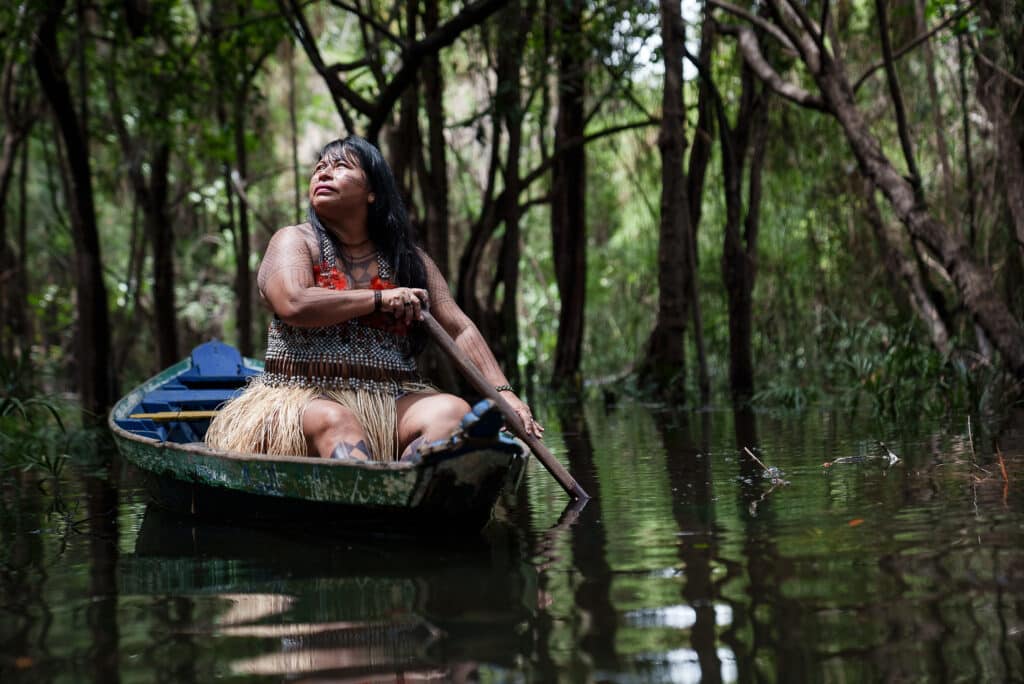
We have already faced giants like Anglo American, which gave up exploiting our territory because we refused to sell our homes. I have had my house broken into twice, my documents stolen, my power cut without explanation. I have been followed, threatened in the street, watched. My young son once hugged me and said, “Mom, I don’t want them to kill you.” That was the moment when, for the first time, I felt fear, and realized this fight is not mine alone. It is a fight for an entire people who know that if we lower our guard, crime will take over everything.
This invasion does not just destroy trees and rivers. It destroys our way of living. Crime wants to dominate the land but also silence our voices. To do this, they target women. They try to co-opt men with bribes, alcohol, and promises of easy money, and when that fails, they threaten wives, daughters, and mothers. That’s why we Munduruku women have decided we will not stay behind anymore. We always stand together in this fight. We do not let the men walk alone in the forest, we walk together, organize vigilance, demarcate our own lands in the absence of government action, and show the government how to truly care for a territory.
It is nothing new that the Amazon has become a showcase for outsiders and a living hell for those inside. Organized crime is intertwined with illegal mining, illegal logging, drug trafficking, and land grabbing. This criminal network deep in the forest launders money, moves millions, destroys the forest, and hides it all under the State’s neglect and complicit politicians.
And who ends up caught in the middle? Us who care for the children, the elders, and our lands. We don’t want medals or prizes to pose in pretty photos. We want to see our daughters playing freely, like I once did, when everything was clean rivers, live fish, and standing forest.
But the fight will not stop. If it depends on us, we will keep entering the forest, launching expeditions, taking photos of bulldozer plates, and reporting those who profit from killing rivers and forests. This is how we say: we do not want more invaders, we do not want organized crime circling our homes, we do not want to see our fish dead, our daughters afraid, our warriors threatened.
Anyone who wants to help the Amazon must understand this: protecting the forest means demarcating land, expelling invaders, and guaranteeing safety for those who care for it. There is no standing forest without protected territory. There is no living Amazon without the peoples of the Amazon alive within it.
That’s why I say: there’s no point in coming to COP30 in Belém to give speeches about a living forest while, on the other side, people keep buying dirty gold, stolen-land soy, illegal cattle, and illegal timber. Those who profit from this push crime straight into our homes. And the ones who truly defend it are us with our bodies, in the forest.
If the State will not do it, we will. But no one should have to risk dying just to prove they have the right to live where they were born. And as long as organized crime hides behind mining, deforestation, and burning, we will keep walking together. Because together, no one silences our voice.
Alessandra Korap Munduruku is one of Brazil’s leading Indigenous leaders. Recognized internationally for her fight against large-scale mining, dams, and infrastructure projects in Indigenous territories, she received the Goldman Environmental Prize in 2023, known as the “Green Nobel.”


