
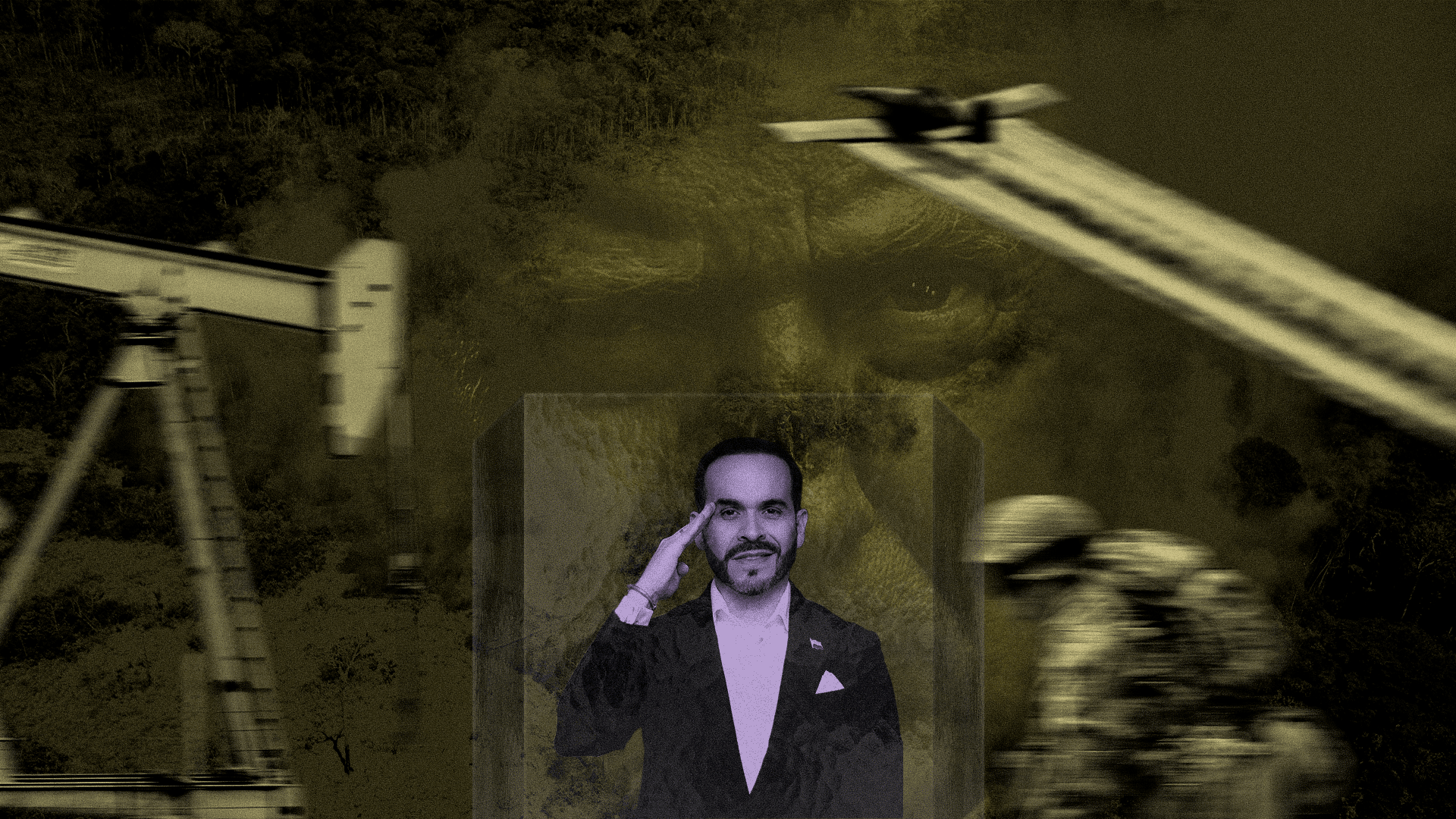
With Colombia’s new president set to take office on August 7, expert Adam Isacson analyzes three proposals by Abelardo De la Espriella (backed by the Trump administration) in our new guest column. He argues they threaten to be a disaster for the Colombian Amazon, while also outlining a different path that remains possible.
By Adam Isacson, director for Defense Oversight at the Washington Office on Latin America (WOLA)
Colombia’s incoming president, narrowly elected on June 21, is promising a blitz of oil production, mining, and agribusiness projects. The “drill baby drill” platform of Abelardo de la Espriella, a far-right populist, has the enthusiastic backing of Donald Trump’s administration in Washington, which wants to expand combat against what it calls “narco-terrorists.” What will that mean for South America’s fragile, fraying Amazon ecosystem?
Colombia, the second most populous state in South America, is an Amazon basin country. Roughly 42,3 percent of its territory is within the Amazon River’s watershed. Its sparsely populated southeast comprises stunningly biodiverse forests and savannas that generate freshwater, sequester millions of tons of carbon from the atmosphere, and have been home to Indigenous peoples for millennia. Colombia has already lost about 3.3 million hectares of forest, an area the size of Belgium, and the problem worsened in the 2020s as armed groups in the area fragmented and began encouraging forest clearing.
Like its neighbors, Colombia already has reasonably well-written laws on its books to protect its Amazon. Whether those laws are enforced, though, depends heavily on the political will of the government in power.
Colombia is now undergoing a transition to a new government. President-elect de la Espriella says that he wants to accelerate resource extraction and intensify a military campaign against the country’s growing list of armed and criminal groups. His rhetoric echoes that heard in another nation that underwent a radical change of government last year: the United States, Colombia’s closest ally, largest trading partner, and principal source of foreign aid.
Three of de la Esprella’s proposals, backed by Donald Trump’s administration, threaten disaster for Colombia’s Amazon.
First, the incoming president wants to open previously untouched areas to drilling, mining, fracking, monoculture, and other extractive activities. All could be enabled by new road and pipeline construction. He proposes to expand the agricultural frontier—the area of the country where uncultivated land is converted to crops—by 1.5 million hectares in just four years. That’s 1.3 percent of the nation’s territory, an area the size of Connecticut.
Second, de la Espriella is calling forcefully for a nationwide military offensive against organized crime. Colombia does need to rid itself of its armed and criminal groups, whose combined estimated membership increased by 23 percent from 2024 to 2025. They are the country’s largest contributors to deforestation, poisoning of water sources, and displacement of Indigenous peoples. At a time when an ounce of gold sells for over $4,000, Colombia’s crime syndicates, gangs, guerrilla remnants, and paramilitary groups could be earning at least as much from illicit mining and logging as they do from drug trafficking.
According to the UN Office on Drugs and Crime (UNODC) and Colombia’s Attorney General’s Office, nearly 85 percent of the country’s gold exports come from illicit activities. This is mainly open-pit or riverside mining that—often with the complicity of corrupt government officials—operates out in the open and dumps alarming amounts of mercury and other poisons into once-clean rivers.
The freedom with which Colombia’s criminal groups operate and enrich themselves is a giant challenge. The Trump administration is defining the hemisphere-wide organized crime phenomenon, which it calls “narco-terrorism,” as one of the top threats to U.S. security. It has added 18 Latin American and Caribbean groups to the State Department’s list of Foreign Terrorist Organizations, bringing the total to 22. Declaring a political coalition called the “Shield of the Americas” and a military effort called the “Americas Counter-Cartel Coalition,” the White House and Defense Department are offering military aid throughout the hemisphere and urging governments to give U.S. troops a more active, on-the-ground role in offensive operations within their borders.
But calling them “narco-terrorists” and sending troops to go kill them doesn’t stop organized crime: that has been tried since the drug war began. Even the most legendary cartel leaders have been killed or extradited to U.S. prisons, yet the problem has only metastasized. Organized crime is harder to fight than guerrillas or “terrorists” because, in fact, it prefers not to fight governments: while it will attack when cornered, its business model depends on government looking the other way. That means corrupting and penetrating government at all levels, rendering it impotent and leaving leaders uncertain about whom to trust within their own states.
This is worsened by the impunity that corrupted officials have enjoyed, as overwhelmed and under-resourced prosecutors, investigators, and judges have barely dented the problem. The fight against organized crime will not work without a robust judicial sector leading the anti-corruption fight. Unfettering the military and sending them out to fight, without a clear plan for curbing state collusion with criminals, doesn’t “solve” organized crime. When confronted on the battlefield, groups fragment, reform, and displace into new territories: an outcome that could be disastrous, like kicking a giant hornet’s nest, in volatile regions like Colombia’s borders with Ecuador and Venezuela.
A single-minded military escalation, unaccompanied by judicial reform and other civilian governance, risks still more human rights abuses—including more threats against those fighting peacefully to preserve the Amazon. Colombia is already the world’s most dangerous country for environmental defenders, and the threat will worsen if a government that misjudges the enemy it is fighting moves to intensify the violence.
Third, de la Espriella wants to bring back aerial spraying of coca, a fast-growing bush mainly grown by small farmers, who minimally process the leaves and sell the product to drug traffickers who refine it into cocaine. The president-elect calls for attacking this poorest link in the cocaine supply chain by applying herbicides from aircraft over the Amazon basin countryside, as well as other parts of the country.
The Trump administration backs this enthusiastically. Between 1994 and 2015, when the program was suspended due to public health concerns, the United States supported a program of spraying the herbicide glyphosate from small planes, which reported killing 1.8 million hectares of coca. Over those years, Colombia’s estimated coca crop fell from a high of 163,300 hectares in 2000 to 48,000 by 2012. To achieve that 115,000-hectares reduction in 12 years, Colombia had to fumigate 1.5 million hectares and manually eradicate 417,200 more.
That’s a ratio of 17 hectares eradicated for every hectare truly reduced. That implies a lot of replanting. In a near-total vacuum of government presence and with no viable economic alternatives, farmers often relocated away from the spray planes and knocked down more forest.
Now, Abelardo de la Espriella is calling for aerial spraying 330,000 hectares of coca that he estimated to be planted in Colombia (261,000, according to official data). Colombia’s Constitutional Court has established important requirements to be met before the start of a new aerial fumigation campaign, such as environmental impact studies and consultations with Indigenous and Afro-descendant communities. De la Espriella interprets those restrictions as applying only to spraying with glyphosate, instead proposing to spray “bioherbicides”—microbes, fungi, or plant extracts—which could disastrously alter fragile Amazon ecosystems.
For the farmers growing coca for income barely above the poverty level, de la Espriella proposes offering assistance to grow licit crops. But the President-Elect also calls for reducing government spending by 40 percent, so it is difficult to imagine a major state presence effort in the ungoverned areas of Colombia where coca is planted.
More promising alternatives to these three risky proposals exist. Colombia needs a 21st-century renewable energy policy rather than more 19th-century fossil fuel extraction. It could be partnering with private enterprise on sustainable, transparent, regulated mining that does no harm, while aggressively pursuing not just illicit mining but especially the corrupt official collusion that enables it. Protection of ungoverned territories where coca is grown, as well as parks and reserves, means establishing a comprehensive government presence that goes well beyond the occasional patrols of soldiers who now pass through.
We should not pre-judge Abelardo de la Espriella’s policies before he is even sworn in. He can back away from his most exaggerated rhetoric and his most simplistic solutions to Colombia’s challenges. Despite having advised and defended criminal figures during his legal career, he can still super-charge a judicial fight against official collusion with criminals.
In his “honeymoon” period, which may be brief, the new president can still pursue these better approaches to halt and reverse the destruction of Colombia’s Amazon. That would be far more promising than a brute-force campaign that erodes the Amazon further while repeating the organized-crime fight’s past mistakes.


