The bombing campaign against alleged drug traffickers moving through the Caribbean Sea and Pacific Ocean, alongside joint military exercises between the United States and Trinidad and Tobago, has increasingly redirected traffickers and their shipments toward routes traversing the Amazon basin. "You hear those motorcycles and motors on the river. It's [drug traffickers] moving at night with their illicit goods!" exclaims a source from Maroa municipality, Venezuela, about the increase in drug trafficking on the Río Negro. These new dynamics are exacerbating pressure from the drug industry on Indigenous territories and clandestine jungle routes, some of which have already become major drug trafficking corridors in recent years.
On September 2, the Trump administration announced the first “lethal strike” against a vessel allegedly engaged in drug trafficking. Washington claims that Nicolás Maduro and his government direct drug trafficking operations, while also blaming Venezuelan organized crime groups like Tren de Aragua and the alleged Cartel de los Soles. Experts question these accusations, citing a lack of evidence regarding both the scale of drug movements and the operational structures of the named networks.
The first attack was preceded by increasingly aggressive rhetoric against criminal activities from Venezuela during August. The United States has labeled the Maduro government’s alleged drug trafficking activities as a “threat to our national security” and has pushed for military deployment in the Caribbean Sea. Between September 2 and December 18, the United States carried out 26 military strikes in the Caribbean and Pacific, killing at least 99 people. Initially, the attacks targeted vessels near Venezuela in the Caribbean Sea, but bombings of boats off the coasts of Colombia and Ecuador have become increasingly numerous.
Relatives of survivors report that innocent fishermen were also attacked during the operations, and many who work in the fishing industry have since remained confined.
“The northern Caribbean route by boat and aircraft, the usual transit method to reach islands including the Dominican Republic, is becoming complicated for them,” noted a senior Colombian security official.
Washington’s operation targeting the Caribbean drug trafficking route faces scrutiny because the Caribbean Sea has never been a primary cocaine corridor to the United States. U.S. Southern Command has reported that 80% of drugs destined for the country actually move through the Pacific Ocean from Colombia and Ecuador.
Venezuela itself, despite having coca crops, is not a major production site compared to Colombia, Peru and Bolivia.
Yet it remains a fundamental transit route, facilitated by law enforcement complicity with the drug trafficking industry.
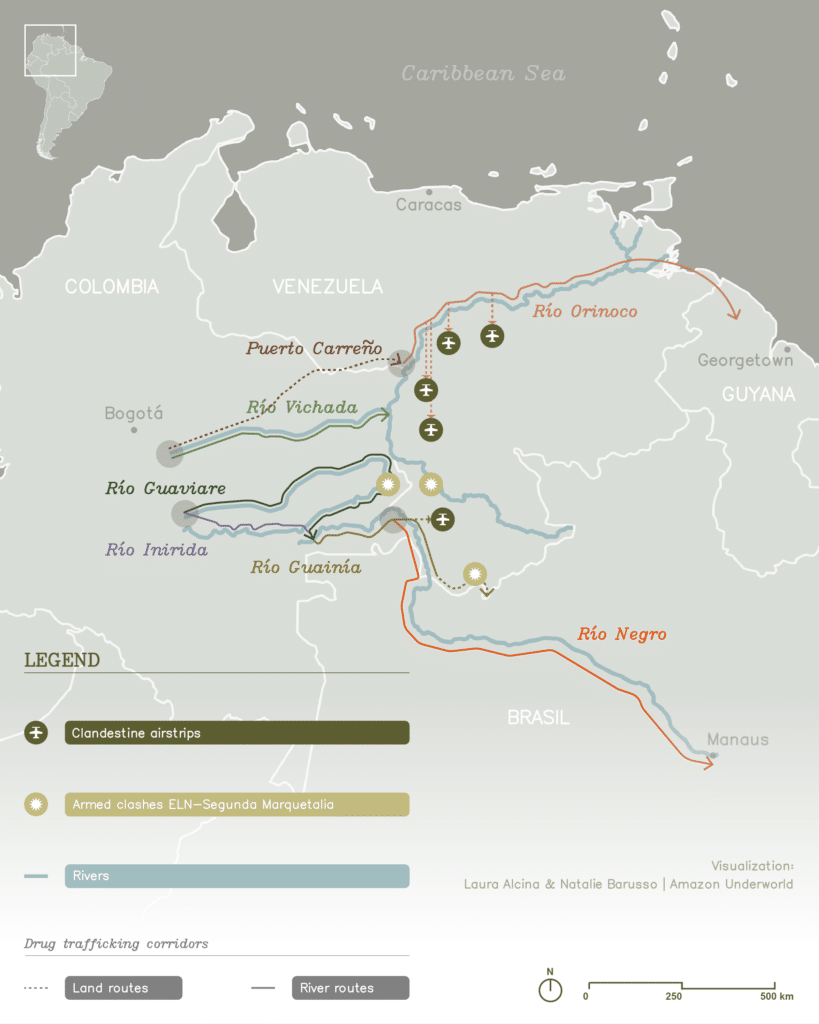
Shipments move along the Orinoco River, which connects with Colombia, before being transferred to semi-submersibles in open sea and loaded onto Europe-bound container ships flying non-Venezuelan flags. The number of clandestine airstrips has also grown, with small planes taking off toward the south or Central America, according to foreign intelligence officials who spoke on condition of anonymity. Meanwhile, rivers like the Guaviare, Inírida and Guainía connect coca-producing areas in Colombia’s interior with Venezuelan routes.
“This route is much safer, but slower,” explained an intelligence official, noting that most narcotics reach their designated departure ports. “We’ve already had information about increased flow through the Río Negro, and also what comes from the center of the country through the Orinoco to be sent out via clandestine airstrips. More movements are projected,” he indicated.

.
Other routes connect with the Guianas (Guyana, Suriname and French Guiana) or overland with Brazil. “Guyana has become the second most important point today, leveraging jungle and river conditions very similar to Colombia’s in this new link in the drug trafficking chain,” stated a senior Colombian armed forces official. The country now hosts shipyards producing go-fast boats, LPVs [low-profile vessels], semi-submersibles and other devices.
“Drugs not leaving through the northern Caribbean are now concentrated in Guyana to be sent through the North Atlantic toward the Iberian Peninsula or Africa,” he added. “Guyana and Suriname have become major semi-submersible shipyards and collection points for drugs from Venezuela.”
AN INCREASINGLY CONTESTED ROUTE
One corridor that has gained significant strength in the Amazon is the Río Negro, passing through Puerto Colombia—a town on the triple border with Venezuela and Brazil—and Maroa, a Venezuelan border municipality. Two armed groups operate in the region: the National Liberation Army (ELN) and the Acacio Medina Front of the Second Marquetalia (SM), a FARC dissident faction. Their criminal alliance collapsed in early August, before the U.S. military deployment in the Caribbean, when the ELN attacked the Segunda Marquetalia in Maroa, determined to eliminate their control. The ELN is attempting to gain total control of the border and strengthen its position in an area rife with illegal gold and critical mineral mining, as well as increasingly strategic drug trafficking routes. Although the groups had previously avoided violent escalations, this clash resulted in several deaths and injuries, forcing dozens of Indigenous community members to flee.
Some of the displaced fled south down the Río Negro, following the same route used by drug traffickers, to São Gabriel da Cachoeira, a small Brazilian city that serves as a drug entry point. “Some displaced people from Maroa and Puerto Colombia arrived here after the clash between the ELN and the dissidents. They’re people who have family here,” says a Venezuelan migrant working as a construction worker in São Gabriel.
A Curripaco activist living on the outskirts of Puerto Inírida says that unrest among her people is also growing. “We don’t know how the security forces are handling this, but boats keep passing by loaded with drugs. Especially at night,” she says.
Indigenous people in this area have been the main victims of violence from illegal armed groups fighting over distribution routes and territorial control. “In the communities there’s a lot of concern, but people speak little and with fear because illegality has control here. The groups do what they want to keep the benefits of drug trafficking,” the activist says.
In mid-September, Brazil’s Federal Police seized a shipment in Manaus containing 1,400 kilos of marijuana and 40 of cocaine. “Those boats go down the Río Negro at night. On their way back, they bring gasoline from here, which they use in the mines to extract gold and to transport drugs from Venezuela,” the Venezuelan migrant recounts.

Competition for drug trafficking routes does not bode well for remote and vulnerable Amazon communities, many of which already face problems with substance abuse and escalating violence.
THE INVISIBLE HUMANITARIAN CRISIS
Authorities and community leaders met in Inírida in late September to address security issues and recent impacts on civil society. Publicly, however, the region’s top authorities and human rights entities have remained silent about the armed groups’ presence and the violence they have unleashed. “A lot of drug trafficking is happening,” an Indigenous leader from Guainía explains, adding that the guerrillas “play the role of the security forces.”
The Guainía governorship has ignored its responsibility to address growing insecurity, multiple sources say. “Territorial entities, especially the departmental governorship, have ignored the risk dynamics in Puerto Colombia and San Felipe,” says a state official. “They minimize these dynamics, generating widespread fear due to lack of state response.” The Guainía Department Security Secretariat did not respond to Amazon Underworld’s request for comment.
In Puerto Colombia and surrounding areas, clashes between the ELN and Segunda Marquetalia have caused an unprecedented crisis. A local merchant was murdered as the ELN seized control of the community previously held by the Acacio Medina Front. “You don’t negotiate with the ELN; with the guerrilla (Segunda Marquetalia) you do,” says a source from the territory, adding that the ELN began charging extortion fees.
An even more complex situation is described by a source on the other side of the river, in Maroa municipality, Venezuela. “They steal the food that merchants bring to town to sell or demand a certain amount of money from them. That’s why merchants sell products at triple what they cost, to recover what was taken from them, and it affects us because we’re the ones buying here. Fishermen are affected because they can’t go out to fish at night like before!” exclaims the same source. “They violate our human rights: they kidnap, kill, mistreat young people, many parents are suffering in silence; they can’t report or do anything about it because they’re threatened with death.”
Security sources and state officials report that the ELN is attempting to gain complete control, with troop movements from both groups throughout Guainía department in Colombia; Amazonas state in Venezuela, and armed clashes even on the Brazilian border near Pico da Neblina.
In Guainía, state officials and Indigenous leaders are reporting a humanitarian crisis. The most invisible consequence is forced confinement: since violence erupted between the two groups, communities have been trapped in their territories, with civilians killed and an unknown number displaced. Local Indigenous leaders say at least 15 communities—some 3,000 families—cannot leave their community limits, making it impossible to hunt, fish, or access their chagras (communal food plots). “In Guainía department, confinement is a war strategy. Whoever controls the population controls the territory,” explains an emergency response source. “About 340 families from the Curripaco, Puinave and Sikuani Indigenous peoples remain trapped by armed conflict dynamics. At least 1,400 people are living under mobility restrictions in the Río Negro area—a serious threat to the physical and cultural survival of these ancestral communities.”
“Fear is constant in the communities. They feel unprotected, excluded from state protection, and geographically isolated,” says an emergency assistance source. “Moving to an urban center can take three days to a week by river or on foot. Without affordable transportation and facing threats from armed groups, communities are trapped without access to clean water, food or health care.” Children face additional dangers: “School access is increasingly challenging due to mobility restrictions, and they face growing risks of forced recruitment or abuse in the conflict.”
Between October and November, non-governmental organizations delivered humanitarian assistance to residents of Puerto Colombia, Tabaquen and La Esperanza. Threats against leaders have also been recorded, and residents have reported the recruitment and involvement of minors in the conflict, as well as rising school dropout rates due to violence in the area.
The clashes will determine who controls the lucrative drug trafficking corridors and illegal mining operations. “Around here, drug trafficking moves on motorcycles, through trails, in boats and speedboats,” says the Maroa source.
Colombian Indigenous leaders confirm the impact of Caribbean and Pacific boat bombings: drug trafficker activity in the area has increased exponentially. More community members are now being hired to transport illicit shipments overland when rapids make river crossings impossible.
As gold prices hit record highs and cocaine increasingly flows through Amazon routes, the unstable tri-border region of Brazil, Colombia and Venezuela sees its rivers dominated by drug traffickers. Those who have inhabited these lands for centuries express a single desire: to be free again, to move freely in their daily work for the well-being and sustenance of their communities.
“For these Amazonian peoples, the river is their only means of survival; when passage is closed, their ability to feed themselves is cut off and their ancestral cultural practices are fractured. This rupture not only deepens hunger but also destroys the communities’ ability to protect each other, leaving them in a situation of extreme vulnerability and defenselessness,” the emergency assistance source concludes.
*Amazon Underworld consulted with approximately 15 sources in Colombia, Venezuela and Brazil, belonging to local communities, state agencies, the humanitarian aid and emergency sector, and intelligence and law enforcement units. Due to security reasons related to their work or residence in high-risk areas, or at the request of state officials for professional reasons, sources have been anonymized.